

One of the challenges for beginning astronomers is learning how to navigate the night sky. Before buying your first telescope, you should familiarize yourself with the stars and constellations.
To start, become familiar with just a few constellations that are visible to the south over the course of a year.
- Leo leads us into spring. Nearby is Virgo and Boötes. Follow an arc from the Big Dipper’s handle to the stars Arcturus and Spica.
- Scorpius and Sagittarius are found low in the horizon in early summer. Higher above them are the three stars of the summer triangle (Altair, Vega, and Deneb) found in the constellations of Aquila, Lyra, and Cygnus.
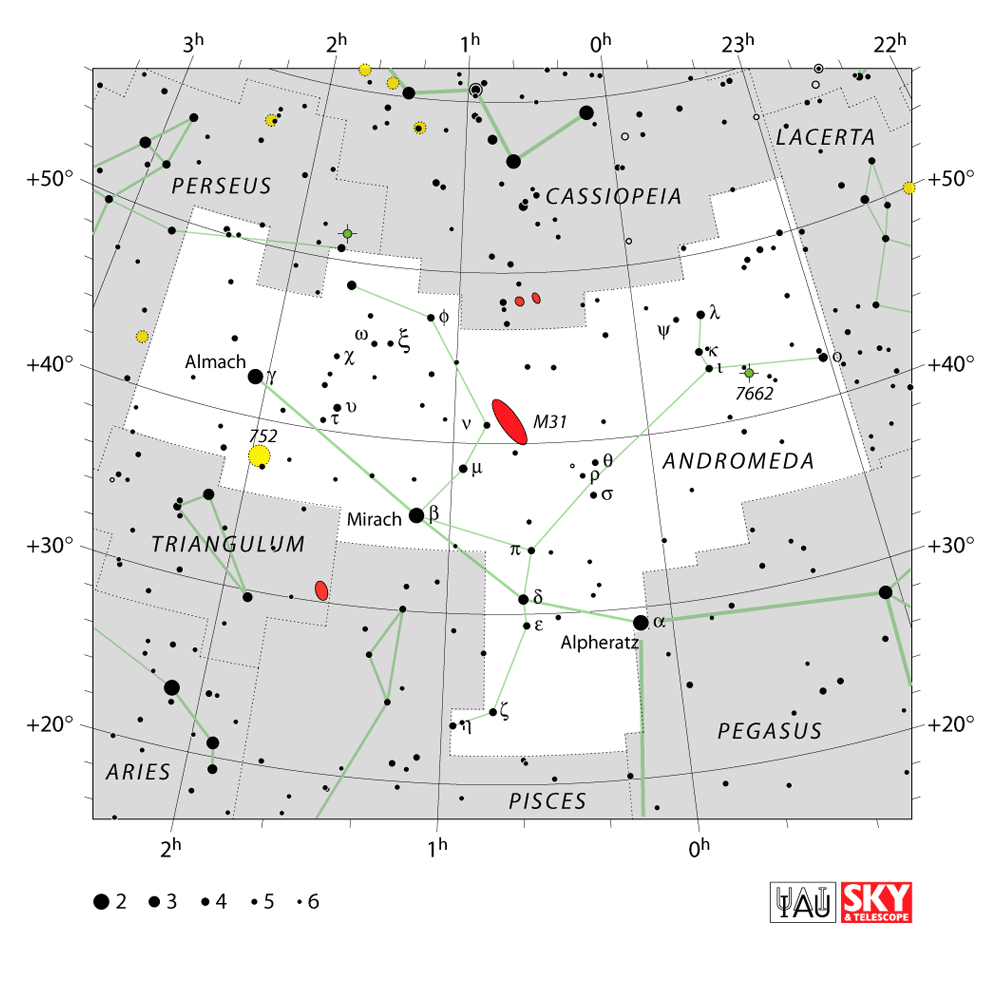
- Pegasus, the upside-down flying horse (or big square) dominates the fall sky. Off to the side is Andromeda. Look for the faint Andromeda Galaxy (M31).
- Orion with its belt and right shoulder (Betelgeuse) is high in the sky during winter. Surrounding the hunter are the constellations of Taurus, Canis Major, Canis Minor, Gemini, and Auriga. Look closely on the back of the bull for the very small “dipper” of the Pleiades.
To the north is the North Star (aka Polaris). It is always found in the same position. Circling around Polaris are two familiar start patterns.
- The Big Dipper (Ursa Major) is found high in the evening sky in spring and low in the fall.
- The W or M shaped Cassiopeia follows the opposite cycle (high in the fall and low in the spring).
Use the two stars at the end of the Big Dipper’s bowl as a pointer and following them to Polaris, which is found at the end of the Little Dipper’s handle (Ursa Minor).
Advanced: The Seasonal Night Skies
If you need some more help, there are several additional maps and references available.
- There are many Astronomy Apps available for your smart phone including Planets, Sky Guide, and SkySafari.
- The folks at Stellarium have a nice online map of the night sky.
- Imaginova Publishing has a Welcome Guide to Astronomy, which includes four seasonal charts of the constellations.
- Sky & Telescope also has seasonal maps of the night sky.
- The Astronomical League has monthly sky charts in both English and Spanish.
- The International Astronomical Union (and Sky & Telescope Magazine) have information and charts for all the Constellations.
- Star Walk has an infographic showing the 7 Easy Constellations Everyone Can Find.