



The world of amateur astronomy is changing. In fact, there just might be a revolution going on. We might be at a watershed moment! The era of the smart telescopes has arrived! These are fully automated telescopes that connect through your smart phone or tablet. They have all the information necessary to find objects in the night sky. And … they take images! Yes, no more squinting through a small eyepiece. You can now sit back and see the cosmos in full living color! Note, however, that these telescopes are not good for imaging the planets. Their focus is on deep-sky objects such as nebulae and galaxies, as well as the Sun (with an appropriate filter), and the Moon.
The most popular at the moment seem to be the ZWO Seestar S30 Pro and the Dwarf Lab Dwarf Mini. However, ZWO just released the larger Seestar S50 Pro (shipping now) and Dwarf Lab introduced the even larger Dwarf Draco a week or so later (ships in November or December 2026).
Many of these telescopes and accessories can be purchased directly from the manufacturer (e.g. ZWO and Dwarf Lab) or from other suppliers of astronomical equipment such as High Point Scientific, Agena Astro, and Astronomics.
Please note that FAS does not officially endorse or recommend these or any other telescopes, accessories, or suppliers. We simply provide information that might be interesting and useful for the public.
Start Here
You might start with one of the several small, compact, and economical smart telescopes from ZWO or Dwarf Labs that are priced in the $400 to $1,000 range. There is also the Dwarf Draco at $1,400 to $1,600. We have some useful information below on the various options. However, If you can’t decide which one is best for you, Anthony Robinson from Skies and Scopes has a short quiz to help you sort through everything.
ZWO SeeStar
In 2024, ZWO launched their first smart telescope, the ZWO Seestar S50 (now discontinued). They soon followed with the smaller and more compact ZWO Seestar S30. These two initial offerings have been followed by the ZWO Seestar S30 Pro and ZWO Seestar S50 Pro with enhanced optics (see our recent posts for more information on the S30 Pro and S50 Pro).
For more about the ZWO Seestar smart telescopes, including detailed purchasing and usage information, see ZWO Seestar Smart Telescopes.
Dwarf Lab
Dwarf Lab has their Dwarf 3, which replaced their earlier Dwarf 2 and is an alternative to the Seestar. The Dwarf Mini is a smaller and less expensive version of the Dwarf 3 (see our recent post on the Mini for more information).
Dwarf Lab just introduced the Dwarf Draco – a much larger and more sophisticated smart telescope, but priced at $1,400 to $1,600. With a 90mm aperture and a longer focal length, this is a step up from the smaller (least costly) smart telescopes from ZWO and Dwarf Lab (see our recent post on the Draco for more information – coming soon).
Which should I buy?
You must make your own choice as to which smart telescope is best for you. In the end, decide how much you want to spend ($400 to $1,600), how much portability do you want, how wide or narrow the field of view (FOV), and the quality of your final images in terms of aperture (larger the better), the sensor (IMX585 and equivalent are better than most), pixel size (larger the better), and number of pixels/MPs (more the better). Here is a very unofficial ranking going from the smallest and least expensive to the largest and most expensive.
- Dwarf Mini (most compact without a tripod): Lowest price with a narrow field of view, 1080 (2.1 MP).
- Seestar S30 (larger with a small tripod): Lowest price with a narrow field of view, 1080 (2.1 MP).
- Dwarf 3: Intermediate price and field of view, 4K (8.3 MP smaller pixels).
- Seestar S50: Discontinued – Price? with a larger 50mm aperture, narrowest field of view, 1080 (2.1 MP).
- Seestar S30 Pro (Wide field of view): Mid to Higher price with the widest field of view, better sensor, 4K (8.3 MP).
- Seestar S50 Pro (Narrower field of view): Higher price with a larger 50mm aperture, narrower field of view, better sensor, 4K (8.3 MP).
- Dwarf Draco: Higher price than the other Seestars and Dwarfs. Larger 90mm aperture, cooled camera, and 12 MP.
- Anthony Robinson. “Which Smart Telescope Should You Buy? (45-Second Quiz).” Skies & Scopes.
- “5 Best Budget Smart Telescopes 2026 (Dwarf Mini, Dwarf 3, S30 Pro, S50 Pro, Draco).” Anthony Robinson | Skies & Scopes/YouTube. October 13, 2026. (9:08)
A Few More Thoughts
By default, both the Seestar and Dwarf telescopes operate in alt/az mode. However, they now can be operated in EQ mode as well. To facilitate this, ZWO supplies an HT fluid tripod head, while Dwarf Labs offers a mini tripod with hydraulic head. Some folks prefer 3rd party heads such as the Sky-Watcher base.
ZWO now has improved Post Processing tools (such as AI Enhance) that gives you much more control over processing your images (including resizing and cropping as needed). Dwarf Labs has an online Stellar Studio, with many tools that will also give you control over your image processing.
Note that these smart telescopes have different sensors and provide a widely different fields of view (FOV). The narrower the field of view, the more “zoomed in” objects will appear. The wider the field of view, the more of the sky can be captured, but objects will appear smaller. You can, however, crop and resize an image to make objects appear larger (e.g., cropped S30/S50 Pro images appear the same size as S30/S50 images). This is usually done during post-processing (see below).


Smart Telescopes from ZWO Seestar & Dwarf Lab – Specifications
- The Dwarf Mini ($420, 30mm, IMX662 sensor, 2.9um pixel size, 2.1 MP, 2.45o FOV) is the smallest and most compact. Tripod not included. Includes a secondary wide-angle camera.
- The Seestar S30 ($400, 30mm, IMX662 sensor, 2.9um pixel size, 2.1 MP, 2.45o FOV) is twice as large as the Mini and comes with a tripod, but is in line with the price and specifications of the Dwarf Mini. More limited wide-angle camera.
- The Dwarf 3 ($550, 35mm, IMX678 sensor, 2.0um pixel size, 8.3 MP, 3.38o FOV) is more expensive, but has better features than the Mini and S30. It has a field of view somewhere between the S30 Pro and S50 Pro. Includes a secondary wide-angle camera.
- The Seestar S50 (Price Used?, 50mm, 2MP, 1.46o FOV) was priced similar to the Dwarf 3, but with a much tighter field of view providing the most “zoomed in” images of all these choices. Although, with a poorer sensor and poorer tracking than the Dwarf 3, it has been DISCONTINUED. No secondary wide-angle camera.
- The Seestar S30 Pro ($700, 30mm, IMX585 sensor, 2.9um pixel size, 8.3 MP, 4.6o FOV) is an upgrade from the S30 with the same 30mm aperture and twice the field of view. It is a quadruplet (vs. the S30 triplet) with an IMX585 sensor resulting in improved image quality. It has a wider field of view that takes in more of the sky than the S50 Pro. It also has an improved secondary wide-angle camera (vs. S30).
- The Seestar S50 Pro ($1,000, OS08B10 sensor, 2.9um pixel size, 8.3 MP, 2.8o FOV) is an upgrade from the S50 with a 50mm aperture providing 2X to 3X more light gathering than the other 30 mm choices. It is a quadruplet (vs. the S50 triplet) with an Omnivision OS08B10 (IMX585 equivalent) sensor resulting in improved image quality. It has a tighter field of view for more “zoomed in” images than the S30 Pro. It also has an improved secondary wide-angle camera (vs. S30).
- The Dwarf Draco ($1,400 Basic, $1,600 SHO, OV50Q40 sensor, 2.4um binning pixel size, 12 MP, 2.1o FOV) is a larger smart scope with a 90mm aperture capturing much more light than the 50mm and 30-35mm alternatives. It has a slightly smaller field of view than the S50 Pro for more “zoomed in images.” It comes in two models – a basic and SHO option. It has a cooled camera that rotates to capture up to 5 minute exposures while still in alt/az mode.
The Process – How to Use a Smart Telescope
Imaging with a smart telescope is relatively easy, but not just a single click and go.
You first have to balance the telescope (alt/az mode) or align it to celestial north (EQ mode). You will then take multiple 10 second to 1 minute images as the telescope tracks your target across the sky. Most telescopes will slowly stack the images to give you a live look at your composite result and you will be able to save the final image to your phone or tablet.
However, you can also go back and review your individual frames (subs) for defects, re-stack your raw images, and post-process the result using tools and techniques available on the smart telescope’s app (e.g. ZWO Post Processing or Dwarf Labs Stellar Studio) or with 3rd party software such as AstroWizard, Siril, Astro Pixel Processor, or PixInsight (once you have more experience with all this). This can usually significantly improve your final image.
Sample Images (ZWO Seestar & Dwarf Lab)

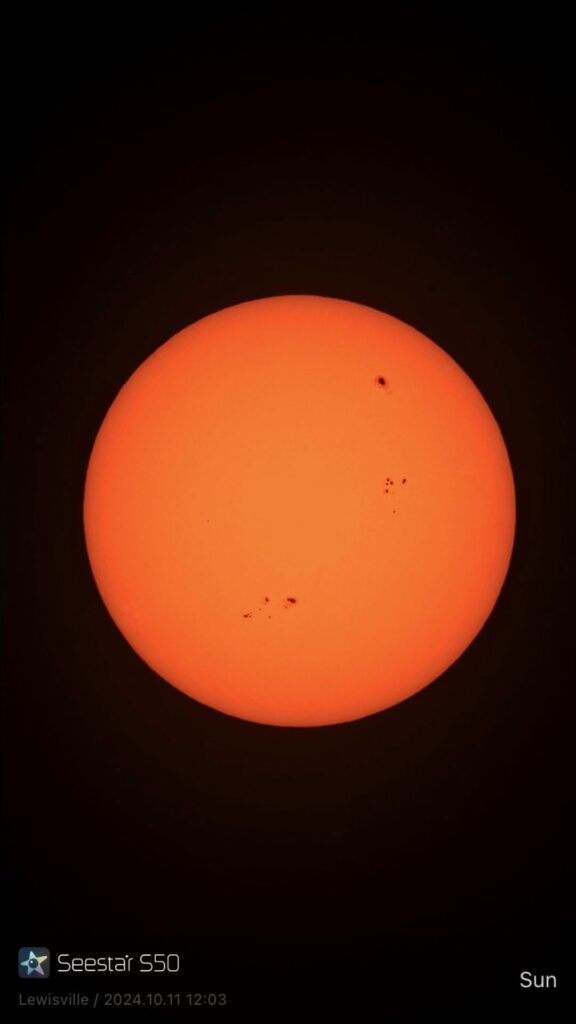


Seestar S50 images. Processed within the Seestar app. Credit: Bruce Gavett


Seestar S30 Images (after post-processing). Credit: Joe Haberthier (Telescopius License: CC BY-NC-SA 4.0)


Seestar S30 Pro images. Post processed using different tools including the Seestar app (left) and Siril (right). Credit: Bruce Gavett


Seestar S30 Pro images. Post processed using Seestar’s AI Enhance process. Credit: Bruce Gavett


Seestar S50 Pro images. Credit: Joe Haberthier


Dwarf 2 & Dwarf Mini images. Credit: Sean Wood
Build Your Own “Smart Telescope”
Another interesting approach is found in a YouTube video by The Space Koala (Build Your Own Smart Scope! Easy as a SeeStar, Pro results!). It utilizes a smart camera from ZWO, a mount also from ZWO, and the Askar V telescope. Below is a list of the hardware discussed in the video (along with a few other choices).

- Telescope: Askar V
- Camera: ZWO ASI585MC Air or ASI2600MC Air
- Mount: ZWO AM3N or AM5N
- Focuser: ZWO EAFN or EAF Pro

The Askar V might be hard to find, however, it is still available at High Point Scientific as of January 2026. There are several other options for the telescope. Askar has a couple alternatives (SQA55 and SQA70). You could also go with a ZWO telescope (FS65, FS80, FS107, FS130). A third option are the Redcat telescopes from Williams Optics (CAT 51, CAT 61, CAT 71, CAT 91). See telescopes for astrophotography for more suggestions.
Additional Options and Comparison of All Smart Telescopes
In addition to the relatively inexpensive smart telescopes offered by ZWO and Dwarf Labs, there are several more sophisticated and expensive smart telescopes on the market to choose from. At the top of the price range ($4,300) is the Celestron Origin Mark II. Other smart telescopes can be purchased from Vaonis and Unistellar. See below for more information on all models.
- Dwarf Labs.
- Dwarf Mini (Dwarf Labs). At around 1.8 lb., this new offering, priced at $400, is advertised as the first pocket smart telescope. For more on this, see our recent post about the Dwarf Mini.
- Dwarf 3 (Dwarf Labs). At just under 3 lb., this is a low priced ($550) alternative to the ZWO Seestar S30 with a 35 mm aperture, 150 mm focal length, and 8.3 MP (2 um pixel size) camera.
- Dwarf Draco. A much larger (12.1 lb.) and more sophisticated smart telescope with a 90 mm aperture and 1200 mm equivalent focal length.
- ZWO.
- Seestar S30. At around 3.5 lb., this is a smaller alternative to the ZWO Seestar S50 and the Dwarf 3.
- Seestar S50. It is around 5 1/2 lb., priced at $550 with a 2 MP camera, 50 mm aperture, and 250 mm focal length.
- Seestar S30 Pro. Launched January 2026 with quadruplet optics, enhanced 8.3 MP sensor, and wide field mode. For more on this, see our recent post about the S30 Pro.
- Seestar S50 Pro. Launched August 2026 with quadruplet optics, enhanced 8.3 MP sensor, and wide field mode. For more on this, see our recent post about the S50 Pro.
- Spectrum Optical Instruments: SPi53 Smart Telescope. More to come …
- Vaonis options are around 11 lb. with a 50 mm aperture and a 245 mm focal length.
- Vespera II has a 8.3 MP camera, optional tripod, and is priced around $1,600.
- Vespera III has an 8.3 MP camera, aluminum tripod, and is priced around $2,500.
- Vespera Pro 2 has a 12.5 MP camera, high carbon tripod, and is priced at $3,000.
- Unistellar.
- Odyssey It is 8.8 lb. with a 5 hour battery life, an 85 mm (3 1/3”) aperture, 320 mm focal length, and 3.4 & 4.1 MP (1.45 um pixel size) camera. It has an autofocuser and does not require collimation.
- Odyssey Base model comes without an eyepiece and is priced at $2,300.
- Odyssey Pro model comes with an eyepiece and is priced at $4,000.
- Expert Range. It is 15.5 lb. with a 114 mm (4 1/2”) aperture, 450 mm focal length, 2.9 um pixel size camera. It has a manual focus and does require collimation.
- eQuinox 2 comes without an eyepiece, 6.2 MP camera, 11 hour battery life, and is priced at $2,500.
- eVscope 2 comes with an eyepiece, 7.7 MP camera, 9 hour battery life, and is priced at $4,900.
- Odyssey It is 8.8 lb. with a 5 hour battery life, an 85 mm (3 1/3”) aperture, 320 mm focal length, and 3.4 & 4.1 MP (1.45 um pixel size) camera. It has an autofocuser and does not require collimation.
- Celestron: Origin Intelligent Home Observatory Mark II. This is Celestron’s high end 6” smart telescope. The total system weighs over 41 lb. It has a 152 mm aperture, 335 mm focal length, 6.4 MP (2.4 um pixel size) camera, and is priced around $4,300.
| Telescope | Weight | Price | Aperture (mm) | Focal Ratio | Focal Length (mm) | Camera (MP) (Format) | Field of View (degrees) | Note |
|---|---|---|---|---|---|---|---|---|
| Dwarf Mini | 1.85 lb. | $420 | 30 (1.2”) | f/5 | 150 | IMX662 (2.1) (1/2.8″) | 2.45 | 7000 mAh storage |
| Dwarf 3 | 3 lb. | $550 | 35 (1.38”) | f/4.29 | 150 (Equivalent 737) | IMX678 (8.3) (1/1.8″) | 3.38 | 10000 mAh storage |
| ZWO Seestar S30 | 3.5 lb. | $400 | 30 (1.2”) | f/5 | 150 | IMX662 (2.1) (1/2.8″) | 2.45 | 6000 mAh storage |
| ZWO Seestar S50 | 5.5 lb. | $550 | 50 (2”) | f/5 | 250 | IMX462 (2.1) | 1.46 | DISCONTINUED |
| ZWO Seestar S30 Pro | 3.6 lb. | $700 | 30 (1.2”) | f/5.3 | 160 (Equivalent 520) | IMX585 (8.3) (1/1.2”) | 4.6 | 6000 mAh storage. Improved optics and wide field view. |
| ZWO Seestar S50 Pro | 6.2 lb. | $1,000 | 50 (2”) | f/5.2 | 260 (Equivalent 880) | OS08B10 (8.3) (1/1.25”) | 2.8 | 10000 mAh storage. Improved optics and wide field view. |
| SPi53 Smart Telescope | 6.1 lb. | $700 | More to come … | |||||
| Dwarf Draco | 12.13 lb. | $1,400 ($1,600 SHO) | 90 (3.5″) | f/3.8 | 340 (Equivalent 1200) | OV50Q40 (12 binning) (1/1.3″) | 2.1 | 1.2um (2.4um 2×2 binning) pixel size. Cooled & Rotating camera for longer exposures. |
| Vaonis Vespera II | 11 lb. | $1,700 | 50 (2”) | f/5 | 250 | IMX585 (8.3) (1/1.2”) | Optional tripod, 28G storage & 4hr battery. | |
| Vaonis Vespera III | 11 lb. | $2,500 | 50 (2”) | f/4.9 | 245 | IMX585 (8.3) (1/1.2”) | Aluminum tripod, 128G storage, & 11 hr battery. | |
| Vaonis Vespera Pro 2 | 11 lb. | $3,000 | 50 (2”) | f/4.9 | 245 | IMX676 (12.5) (1/1.6”) | High carbon tripod, 256 G storage, & 11 hr battery. | |
| Unistellar Odyssey Base | 8.8 lb. | $2,300 | 85 (3.3″) | f/3.76 | 320 | 3.4 | Auto focusing. | |
| Unistellar Odyssey Pro | 8.8 lb | $4,000 | 85 (3.3″) | f/3.76 | 320 | 4.1 | Auto focusing. Eyepiece. | |
| Unistellar eQuinox 2 | 15.5 lb. | $2,500 | 114 (4.5”) | f/3.95 | 450 | 6.2 | Manual focusing & collimation. | |
| Unistellar eVscope 2 | 15.5 lb. | $4,900 | 114 (4.5”) | f/3.95 | 450 | 7.7 | Manual focusing & collimation. Eyepiece. | |
| Celestron Origin Mark II | ~ 40 lb. | $4,300 | 152 (6”) | f/2.2 | 335 | 6.4 |
References and Reviews of Specific Models
- “The Dwarf Mini (Smart Telescope).” FAS. May 2026.
- “The Seestar S30 Pro (Smart Telescope).” FAS. December 2025.
- “The Seestar S50 Pro (Smart Telescope).” FAS. September 2026.
- “The Dwarf Draco (Smart Telescope).” FAS. Coming soon.
- Barry Collins. “Dwarf 3 Review: Is This Tiny Telescope A Genuine Wonder?” Forbes. February 1, 2025.
- Trevor Jones. “Dwarf 3 Smart Telescope Review.” AstroBackyard. November 23, 20424.
- Phil Harrington. “DwarfLab’s new tiny smart scope packs a punch.” Astronomy. August 15, 2024.
- Anthony Robinson. “Dwarf 3 Smart Telescope: How Does It Compare To The Dwarf 2?” Skies & Scopes. August 1, 2024.
- Anthony Robinson. “Dwarf 2 vs ZWO Seestar S50: Which One Should You Buy?” Skies & Scopes. August 1, 2024.
- “Is THIS the BEST SMART Telescope in the world?” Damon Scotting/YouTube. April 5, 2024.
- “Dwarf Draco.” Dwarf Labs. Post 1, Post 2, Post 3, Post 4.
- “First Look at The Dwarf Draco Smart Telescope Speculation Leaks.” Ember Sky Media/YouTube. August 31, 2026. (20:19)
- “New Dwarflab DRACO 90mm | The Future of Smart Telescopes?” Galaxy Art Media/YouTube. August 30, 2026. (2:46)
- “DWARFLAB Draco: Reverse Engineering a Rumored Telescope From Six Independent Clues.” Dwarfastro. August 4, 2026.
- “ZWO Seestar All-In-One-Telescope.” High Point Scientific.
- Sarah Peasgood. “The Seestar S50 is among the cheapest smart telescopes available. But is it any good? We put it to the test.” BBC Sky At Night Magazine. April 19, 2024.
- Anthony Robinson. “ZWO Seestar S50 Review: Perfect for Astrophotography Beginners.” Skies & Scopes. February 26, 2024.
- Jamie Carter. “ZWO SeeStar S50 smart telescope review.” space.com. May 23, 2024.
- “Seestar S50 Review.” AstroBackyard. December 12, 2023.
- Tony Huffman. “ZWO Seestar S50 Review.” PC Magazine. May 16, 2024.
- Jamie Carter. “ZWO Seestar S50 review: bringing smart telescopes to the masses.” Digital Camera World. April 27, 2024.
- Al Milano. “Review Of The Seestar S50 (Smart Telescope) by ZWO.” AstroMart.
- Trevor Jones. “Seestar S50 In Depth Review.” AstroBackyard. October 25, 2024.
- Tim Trott. “Getting the Most from the ZWO Seestar S50 – Specs, Tips and Tricks.” Perfect Astronomy. January 22, 2024.
- Tom Harnish. “Unofficial Seestar S50 User Guide.” June 2024.
- “Seestar for Dummies.” Astronomy Tips and Reviews with Curtis/YouTube.
- “ZWO Seestar S50 50mm f/5 All-in-One Smart Telescope.” B&H Photos Video Audio.
- “My SeeStar S50 Full Review. Is It Worth The Hype?” Delta Astrophotography/YouTube. December 27, 2023.
- “Seestar S50 – One year on from release – does it live up to the hype?” StargazerMan/YouTube. June 24, 2024.
- “It’s Not That Good – Review of the Seestar S50. Plus: What’s Wrong With Smart Scopes? Let’s Look!” Ed Ting/YouTube. March 24, 2024.
- “AMAZING images with the Seestar SMART TELESCOPE⚡ FULL tutorial, Free Software ONLY!” Cuiv, The Lazy Geek/YouTube. July 5, 2024.
- Phil Harrington. “Astronomy tests ZWO’s Seestar S30.” Astronomy Magazine. October 8, 2025.
- Ashley Northcotte. “ZWO Seestar S30 Review.” AstroBackyard. July 6, 2025.
- Sarah Peasgood. “ZWO Seestar S30 smart telescope review.” BBC Sky at Night Magazine. June 1, 2025.
- “SEESTAR S30 | Trial & Review! Best smart scope under $350.” ScottCastrophotography/YouTube. November 17, 2024.
- High Point Scientific. High Point Scientific Team. “Seestar S30 Smart Telescope Review,” AstronomyHub, High Point Scientific. November 1, 2024.
- “Vaonis Vespera 3 & Pro 2 — What’s New (And Who Should Buy One).” Anthony Robinson | Skies & Scopes/YouTube. April 15, 2026.
- Anthony Robinson. “Vaonis Vespera II Review: Recommended Smart Telescope for 2024.” Skies & Scopes. March 22, 2024.
- Anthony Robinson. “Vaonis Vespera Pro Review: The Best Compact Smart Telescope?” Skies & Scopes. March 13, 2024.
- Raymond Shubinski. “Vaonis’ Vespera smart scope reviewed.” Astronomy. February 21, 2024.
- Anthony Robinson. “Unistellar Odyssey Review: A New and Seamless User Experience.” Skies & Scopes. Updated August 1, 2024.
- Raymond Shubinski. “Unistellar eQuinox 2 smart telescope review.” Astronomy. April 24, 2024.
- “Is THIS the BEST SMART Telescope in the world?” Damon Scotting/YouTube. April 5, 2024. (See review of the eVscope 2)
- Brett Tingley. “Celestron Origin Intelligent Home Observatory smart telescope review.” space.com. September 4, 2024.
- Anthony Robinson. “Celestron Origin vs Unistellar Odyssey Pro: Which is Best For You?” Skies & Scopes. July 26, 2024.
- Anthony Robinson. “Celestron Origin Review: The Best Smart Telescope Yet?” Skies & Scopes. March 22, 2024.
- “Celestron Origin Mark II Smart Telescope.” High Point Scientific.
- “Celestron Origin Mark II Intelligent Home Observatory.” Agena Astro.
Additional References and Reviews of Smart Telescopes
- Anthony Robinson. “Best Smart Telescopes 2026 (Seestar, Dwarf, Unistellar, Vaonis, Celestron).” Skies & Scopes. April 24, 2026. Updated September 7, 2026.
- Anthony Robinson. “Smart Telescopes.” Skies & Scopes.
- Trevor Jones. “The Best Smart Telescopes in 2025.” AstroBackyard. Last updated: November 22, 2025.
- Pete Lawrence. “The cosmos at the click of a button. These new gadget telescopes are changing how we view the night sky.” BBC Sky at Night Magazine. November 17, 2025.
- Kimberley Lane. “Best smart telescopes 2025: Navigate the night skies with ease.” space.com. Updated April 8, 2025.
- Jamie Carter. “The best smart telescope in 2024.” Digital Camera World. Updated June 10, 2024.
- Daniel Hani. “The smart telescope revolution: transforming astronomy.” BBC Sky at Night Magazine. July 16, 2024.
- Jamie Carter. “Why smart telescopes are the future of astrophotography.” Tech Radar. September 24, 2022.
- “IMX585 vs IMX678: A Detailed Comparison for Microscope Camera Sensors.” AliExpress Wiki.
- “DON’T BUY A TELESCOPE UNTIL YOU SEE THIS: TOP 5 SMART MODELS.” SoMuchTech/YouTube. September 12, 2026. (8:41)
- “I Tested EVERY SMART Telescope on the Market…These are the results!🤔🤯🔭.” Damon Scotting/YouTube. August 30, 2026. (11:05)
- “5 Telescope Brands DYING in 2026 (And 3 Taking Over).” Trillion Dollar Sky/YouTube. July 31, 2026. (9:00)
- “10 Smart Telescopes Ranked: Which One Is Worth Your Money?” Trillion Dollar Sky/YouTube. July 8, 2026. (8:42)
- “Best Budget Smart Telescope 2026? Seestar S30, S30 Pro & S50 vs Dwarf 3 & Mini.” Wido’s AstroForum/YouTube. February 12, 2026. (26:27)
- “Don’t Buy a Smart Telescope Until You Watch This (11 Models Compared).” Anthony Robinson | Skies & Scopes/YouTube. October 14, 2025. (17:44)
- “Build Your Own Smart Scope! Easy as a SeeStar, Pro results!” The Pace Koala/YouTube. July 6, 2025. (22:53)
- “What is the BEST Smart Telescope? eVscope Vs. DWARF II Vs. Seestar Vs. Vespera Full Imaging Test!” Galactic Hunter/YouTube. December 12, 2023. (15:36)
More from FAS
You must be logged in to post a comment.