FAS Astronomers Blog, Volume 34, Number 6.
Andromeda was the princess from Greek mythology. She was the daughter of Cepheus, the king, and Cassiopeia, the queen. As a princess, Andromeda was a little vain and often boasted of her beauty. This angered Poseidon who somehow had Andromeda chained to a rock and sent the sea monster Cetus to kill her. Fortunately for Andromeda, Perseus, a Greek hero and slayer of monsters, just happened by on his way home from beheading Medusa, who’s mere glance would turn someone to stone. He sees Andromeda, falls in love, rescues her, and, in the process, turns both Cetus and Phineus, Andromeda’s former fiancée, to stone using Medusa’s head. Perseus and Andromeda get married and they have many children. After she dies, which we assume is at an old age, Athena places Andromeda into the night sky as a constellation near many of the others, including Cepheus, Cassiopeia, Perseus, and even Cetus.
The Andromeda constellation itself is most visible in the fall off one corner of the great square of Pegasus. It is one of the original constellations published in The Almagest by Claudius Ptolemy in 150 CE. One of its most noticeable features is a row of bright stars (Alpheratz, Mirach, and Almach) extending from Pegasus up toward Perseus. There is a fainter row of stars in the same direction, which parallels this one. Some say they might be the hindlegs of the winged horse Pegasus.
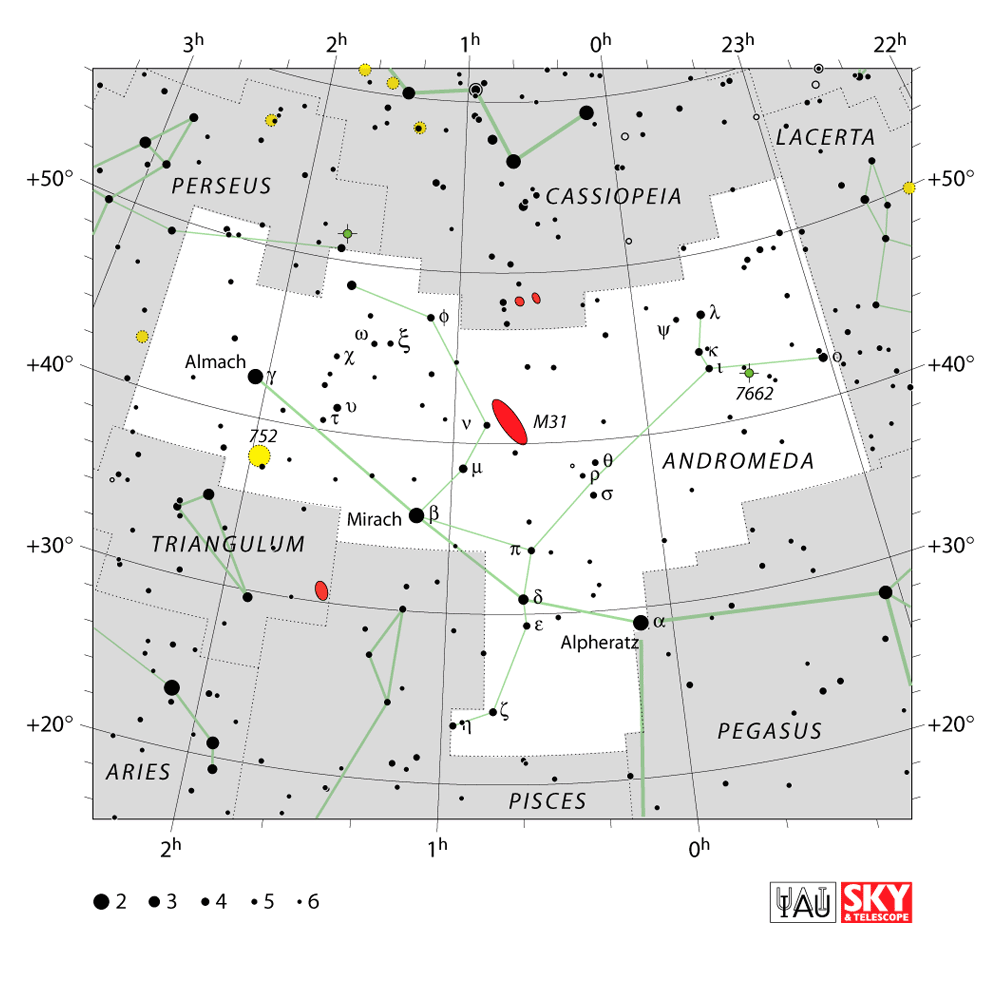

However, we’re here to talk about the Andromeda galaxy, which is the most striking feature (and object) in the constellation of Andromeda.
For a long time, when astronomers looked up at the night sky, they saw what appeared to be faint smudges of light, which they called nebulae. Some were clearly lying within our Milky Way galaxy. Others of these so-called nebulae were much more perplexing. They looked like swirling blobs of gas and dust, in which case they and the universe at large was most likely constrained to just the Milky Way. However, they could also be islands of stars in their own right, implying a much larger and expansive universe.
The most debated of these objects was the Andromeda nebula. Astronomers would ask: How far away is it? How large is it? The debate came to a head on April 26, 1920, with The Great Debate. It was the older and more established Heber Curtis who argued for a more expansive universe and the younger Harlow Shapely who defended the Milky Way as the full extent of the universe. It wasn’t clear who won or, at the time, who was right.
The answer came later in 1925 when Edwin Hubble found a variable star in the Andromeda nebula, and he estimated the distance to the nebula to be 900,000 light years away. This was well beyond the bounds of the Milky Way. This clearly showed that many of these nebulae were truly galaxies themselves, and the universe was much larger than many had thought. Hubble’s estimate for the distance to Andromeda proved to be on the conservative side. We now think, based on modern measurements, that the Andromeda galaxy is around 2 ½ million light years away.
It should be noted that Henrietta Swan Levitt deserves much of the credit for Hubble’s discovery. She was one of the so-called Harvard Computers, who worked on cataloging stars for Edward Pickering at the Harvard Observatory. She developed a relationship between the luminosity of Cepheid variable stars and their period of brightness, which Hubble used to determine the distance to Andromeda.
Hubble also measured the distance to other galaxies, as he now knew what they were, and began observing characteristics of light from these galaxies. He utilized something called the Doppler effect along with the fact that light from galaxies exhibits dark lines, which identify the composition of gas within galactic stars. Light waves from galaxies receding from us are stretched out and shifted toward the red end of the spectrum. On the other hand, light waves from galaxies approaching us are compressed together and shifted toward the blue. Hubble along with Vesto Slipher and Milton Humason measured the Doppler effect for several galaxies and found that, rather than a random distribution between red and blue shifts, most are red shifted. That is, most galaxies are moving away from us, and they also discovered that the further a galaxy is from us the faster it is receding. This is known as Hubble’s law and soon became the standard measurement of the expansion of the universe.
However, a few galaxies, and particularly Andromeda, are blue shifted. They are part of what we call the Local Group of galaxies – many of which are moving toward us. The Local Group contains around 100 gravitationally bound galaxies within a sphere of space some 17 million light years across. The Milky Way and Andromeda (M31) are the two largest members of this group. They have a similar spiral structure, although, we think Andromeda might be the larger of the two. A third, somewhat looser spiral, is the Triangulum galaxy (M33). The Large and Small Magellanic Clouds, companion galaxies of the Milky Way, are also within the Local Group, as are M110 and M32 – companion galaxies of Andromeda.


Andromeda is the farthest object we can see in the night sky without the aid of a telescope or binoculars. It is also one, if not the most, photographed deep-sky object and is a popular target of amateur astrophotographers as well as NASA. In 2025, The Hubble Space Telescope released a mosaic of the Andromeda galaxy. This image is a composite of 600+ Hubble photos captured over a 10-year period. It shows some 200 million stars spread out over a 2.5-billion-pixel image.


Andromeda and the Milky Way appear to be moving toward each other, and they will eventually merge (we think) in another 4 to 5 billion years – mark it on your calendar to make sure you don’t miss it. The stars themselves will not collide, although the gravitational force from the two galaxies will shuffle them around a bit. The galaxies will swing by each other and then pull back and settle into an elliptical galaxy called Milkomeda. However, things have changed. A recent study now speculates that there is only a 50-50 chance of the two galaxies colliding. We’ll keep an eye on this story and provide updates as they occur.
As noted above, Andromeda is a spiral galaxy similar in shape to the Milky Way. It is known as Messier 31 (M31) from the catalog developed by Charles Messier back in the 1700s. It stretches 3 degrees across the night sky (six times that of the Moon) and has an apparent magnitude of 3.4. Andromeda is around 150,000 light years across (a bit larger than the Milky Way) and contains around one trillion stars. Just as the Milky Way does, Andromeda likely has a black hole at its center.
To find the Andromeda galaxy in the night sky, use either Cassiopeia or Pegasus as guides.
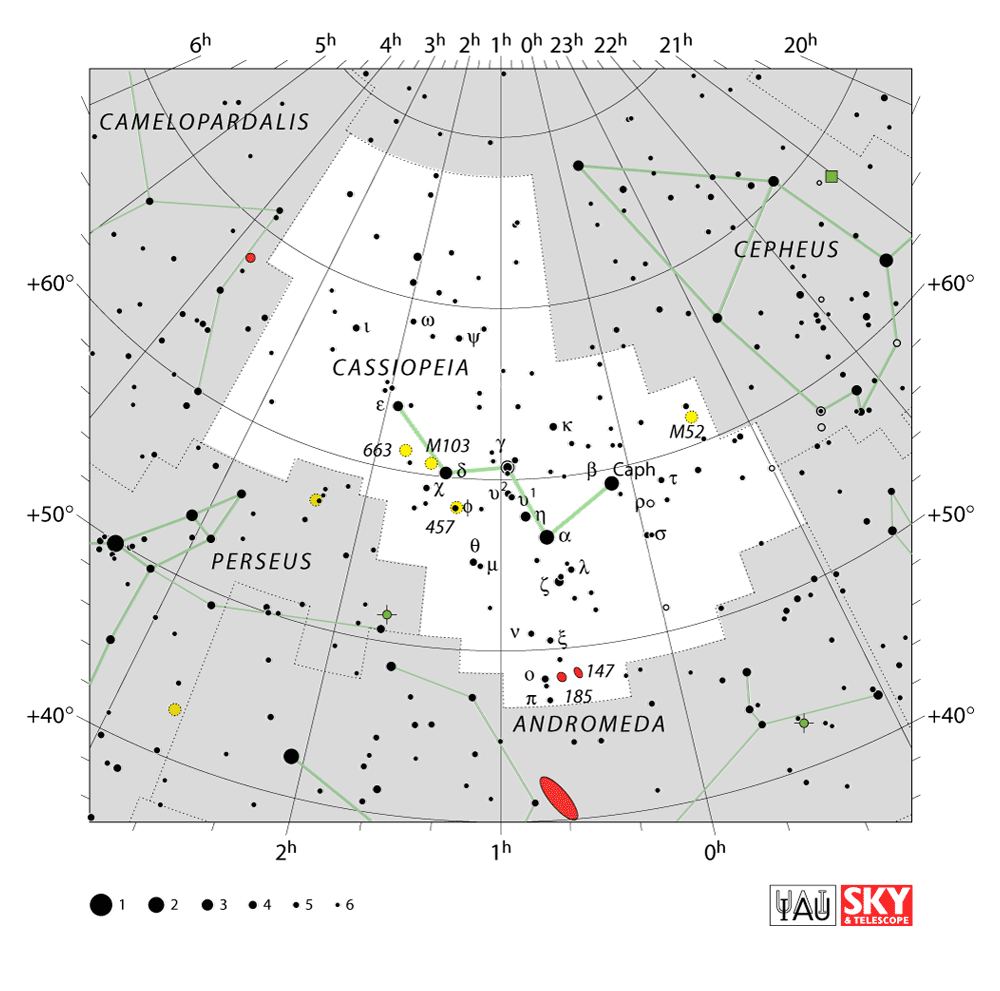

- Looking north, Cassiopeia appears as a W in the night sky. Find the star Schedar which is the lowest point of the W and follow it in a direct line to the Andromeda galaxy.
- Looking south, Pegasus appears as an upside-down flying horse. However, it also looks like a large square – known as the Great Square of Pegasus. Start with the upper left corner of the square and count out two stars to the star Mirach – you are now technically in the constellation Andromeda. Then count up … one (to Mu Andromedae) … two (to the galaxy). This will take you to the Andromeda galaxy. You can also go out both “front legs” to Mirach and another star below it. Draw a line from the lower star to Mirach and extend it the same distance to the Andromeda galaxy.


Things with Andromeda have recently become unsettled. The James Webb Space Telescope (JWST) has just peered into the heart of Andromeda, and a few astronomers have found the view somewhat disconcerting. There is evidence that Andromeda has gobbled up many smaller galaxies and may still be doing so. The black hole at the center of Andromeda might be becoming more active. The projected merger of the Milky Way and Andromeda also might be sooner than expected and more violent than previously thought. These are all very preliminary conclusions … so keep on the lookout …
Before we go, here are a few images of the Andromeda galaxy.


Appendix – Hubble’s Law
Hubble’s Law is usually stated as, H0 = v / d, where H0 is Hubble’s constant, v is the velocity (km/sec) with which a galaxy is receding, and d is the distance of the galaxy (Mpc). There is some uncertainty as to the exact value of the Hubble constant – something that is referred to as the “Hubble Tension.” Different measurement methods have yielded inconsistent results ranging from around 67 (km/s)/Mpc (based on the LCDM model and Cosmic Microwave Background) to around 73 (km/s)/Mpc (using standard candles).
Selected Sources and Further Reading (Andromeda in Greek Mythology)
- “Andromeda.” Greek Mythology.
- Madeleine. “Andromeda in Greek Mythology: The Legendary Princess.” Theoi Greek Mythology. November 26, 2019.
- Avi Kapach. “Andromeda.” Mythopoeia. March 10, 2023.
- Guillaume Henry. “Perseus and Andromeda: The Complete Myth, Sources, and Hidden Depths.” Mythologis. August 11, 2026.
Selected Sources and Further Reading (Andromeda the Constellation)
- “Andromeda.” IAU Constellations.
- “Andromeda Constellation.” Constellation Guide.
- “Alpheratz (Alpha Andromedae).” Star Facts. November 24, 2025.
- “Mirach.” Star Facts. October 28, 2018.
- “Almach.” Star Facts. April 22, 2020.
- Kelly Kizer Whitt. “The constellation Andromeda the Chained Lady.” EarthSky. November 27, 2025.
- Dominic Ford. “The Constellation Andromeda.” In-The-Sky.org.
- Michael E. Bakich. “Explore the wonders of the constellation Andromeda.” Astronomy Magazine. July 30, 2025. Updated July 31, 2025.
- “Andromeda (The Chained Maiden) Constellation.” The Sky Live.
- “A History of the Constellations.” FAS Astronomers Blog. February 2025.
Selected Sources and Further Reading (Andromeda Galaxy)
- Bruce McClure. “The Andromeda galaxy: All you need to know.” EarthSky. September 12, 2025.
- Ron Voller. “Unveiling the Andromeda Galaxy’s true nature.” Astronomy Magazine. October 10, 2025.
- “Andromeda Galaxy.” Universe Map.
- Iain Todd. “Andromeda Galaxy: Complete Guide And How To See It.” BBC Sky at Night Magazine. November 28, 2023.
- “James Webb Telescope Just Observed Andromeda Galaxy.” James Webb Discovery. August 20, 2022.
- Marcia Bartusiak. The Day We Found the Universe. Penguin/Random House/Pantheon Books, New York, 2009.
- “Messier 31 (Hubble Image).” NASA.
- “The Great Debate.” FAS Astronomers Blog. April 2020.
- “The Harvard Computers.” FAS Astronomers Blog. March 2020.
Selected Sources and Further Viewing (Andromeda Galaxy)
- “Daniele Ferrari – Journey Inside Andromeda -.” Daniele Ferrari/YouTube. February 24, 2025. (5:01).
- “Andromeda Galaxy: All You Need to Know About Our Galactic Neighbor.” EarthSky/YouTube. November 15, 2025. (3:14)
- “Journey Deep Inside the Andromeda Galaxy | Documentary For Sleep.” Sleep on Science/YouTube. October 2, 2025. (2:09:41)
- “Journey to the Andromeda Galaxy [4K].” SEA/YouTube. January 5, 2022. (35:18)
- “A Journey Through The Andromeda Galaxy.” Insane Curiosity/YouTube. March 18, 2023. (18:59)
- “A Brief History of the Andromeda Galaxy.” Gary Fildes – A Bricklayers guide to the Galaxy/YouTube. September 20, 2029. (20:39)
- “How Far Away Is It – Chapter 11 – Andromeda and the Local Group (4K).” David Butler/YouTube. July 28, 2020. (27:20).
Selected Sources and Further Reading (The Local Group)
- “The Local Group.” Imagine the Universe/NASA/GSFC.
- “The Local Group is our galactic neighborhood.” EarthSky. October 24, 2023.
- Katherine Kornei. “The Local Group: Our galactic neighborhood.” Astronomy Magazine. August 5, 2019.
- Ezzy Pearson. “The Local Group: A Guide To Our Galaxy’s Neighbourhood.” BBC Sky at Night Magazine. September 3, 2020.
Selected Sources and Further Reading (Milkomeda)
- “What will happen to the solar system when the Milky Way and Andromeda Galaxy merge?” Astronomy Magazine. February 10, 2025.
- “The Andromeda and Milky Way collision, explained.” Astronomy Magazine. December 1, 2023. Updated December 12, 2023.
- Robert Lea. “The Milky Way may not collide with neighboring galaxy Andromeda after all: ‘From near-certainty to a coin flip‘.” Space.com. June 2, 2025.
- Till Sawala, Jehanne Delhomelle, Alis J. Deason, et al. “No certainty of a Milky Way–Andromeda collision.” Nature Astronomy. Volume 9 (8). Pages1206–1217. June 2, 2025.
Selected Sources and Further Viewing (Milkomeda)
- Frank Summers. “Crash of the Titans: Milky Way & Andromeda Collision.” NASA Scientific Visualization Studio. May 23, 2018.
- “Andromeda Is Coming: The Fate of the Milky Way.” The Quite Observatory/YouTube. January 16, 2026. (28:19)
- “Collision of MILKYWAY & ANDROMEDA | The Great Galactic Collision | Alive Beyond.” Alive Beyond/YouTube. July 14, 2025. (11:27).
- “The Final Hour – When Andromeda Hits The Milky Way.” Boring Space/YouTube. November 19, 2025. (2:06:57)
Selected Sources and Further Reading (JWST Looked into Andromeda)
- “James Webb Telescope Terrifying Discovery About the Andromeda Galaxy.” Science & Nature/YouTube. April 30, 2025.
- “The James Webb Telescope Discovers Something Shocking in the Andromeda Galaxy.” News Science & Nature. May 10, 2025.
Selected Sources and Further Viewing (JWST Looked into Andromeda)
- “James Webb Saw the Center of Andromeda for the First Time — NASA Is HORRIFIED!” BRIGHT SIDE Series/YouTube. September 16, 2026. (1:01:46)
- “James Webb Looked Into Andromeda… What It Discovered Shocked Scientists.” Beyond Horizons/YouTube. March 26, 2026. (2:25:55)
- “James Webb Finally Looked Into Andromeda… What It Saw Shocked Scientists.” Cosmic Vision/YouTube. March 19, 2026. (56:31)
- “James Webb Looked Into Andromeda… What It Saw Terrified Scientists.” Late Science/YouTube. December 25, 2025. (2:06:47)
For more articles like this see
You must be logged in to post a comment.