



Image Credits: Joe Haberthier
Observing the night sky can be a great activity. However, taking images can be much more rewarding. The problem is that astrophotography can be complicated and expensive. The good news is that there are new technologies such as smart telescopes and smart cameras that make the journey much easier. So, here is an introduction to get you started. If you’re new to astronomy and stargazing in general, you might first take a look at our astronomy and stargazing introductory page.
Deep-Sky Objects
Before you begin, it helps to learn something about the night sky. You might start with our Introduction to the Night Sky to find your way around. Most astrophotographers go after deep-sky objects, although some photograph the planets. There are six types of deep-sky objects. The top 110 are classified as Messier objects (with M## designations). Others are found in the Cadwell Catalog (with C## designations). Most are also included in the New General Catalog (NGC####) and Index Catalog (IC####). Go here for our overview of deep-sky objects.
- Open Star Clusters are small and younger clusters of stars that formed at approximately the same time (e.g., the Pleiades/M45).
- Globular Star Clusters are larger and older clusters of stars found outside the plane of the Milky Way. These clusters are over 10 billion years old and contain hundreds of thousands to millions of stars (e.g., the Hercules Globular Cluster/M13).
- Nebulae are gaseous clouds, typically composed mostly of hydrogen, where new stars are being formed (e.g., the Orion Nebula/M42).
- Supernova Remnants are nebula composed of material that was ejected during a supernova explosion. (e.g., the Crab Nebula/M01).
- Planetary Nebulae are the remnants of stars after they expanded into a red giant where material was blown away from the surviving star core (e.g., the Ring Nebula/M57).
- Galaxies are large collections of stars such as the Milky Way and Andromeda (M31).


A Few Deep-Sky References
- Left Turn at Orion by Guy Consolmagno and Dan M. Davis. You can find this book on Amazon. They have a Left Turn at Orion webpage as well.
- “Objects In the Night Sky.” In-The-Sky.org. Information about what is currently visible.
- “Deep Sky Designations (M, NGC, IC, and more).” FAS.
- Catalogs.
- “Messier Objects.” Constellation Guide.
- “Messier Catalogue.” Messier Objects.
- “The Messier Objects.” in-the-sky.org.
- “Caldwell Catalogue.” Constellation Guide.
- “The New General Catalog (NGC).” in-the-sky.org.
- “The Index Catalog.” in-the-sky.org.
Traditional Telescopes
It doesn’t hurt to start your viewing of the night sky with a traditional telescope or even a pair of binoculars. Check out our Telescope Basics page for an introduction on how to purchase and use a more traditional telescope.
Smart Telescopes
As noted above, there are several smart telescopes available that do much of the work and are a great introduction to astrophotography. ZWO has the Seestar S30, S50, and S30 Pro, which retail for $600 or less. Dwarf Labs has its Dwarf III and Dwarf Mini, which are also in the $400 to $600 range. Both can be operated from smart phone and tablet apps. There are other smart telescopes on the market, however, they are much more expensive. For more information, see our introduction to smart telescopes.


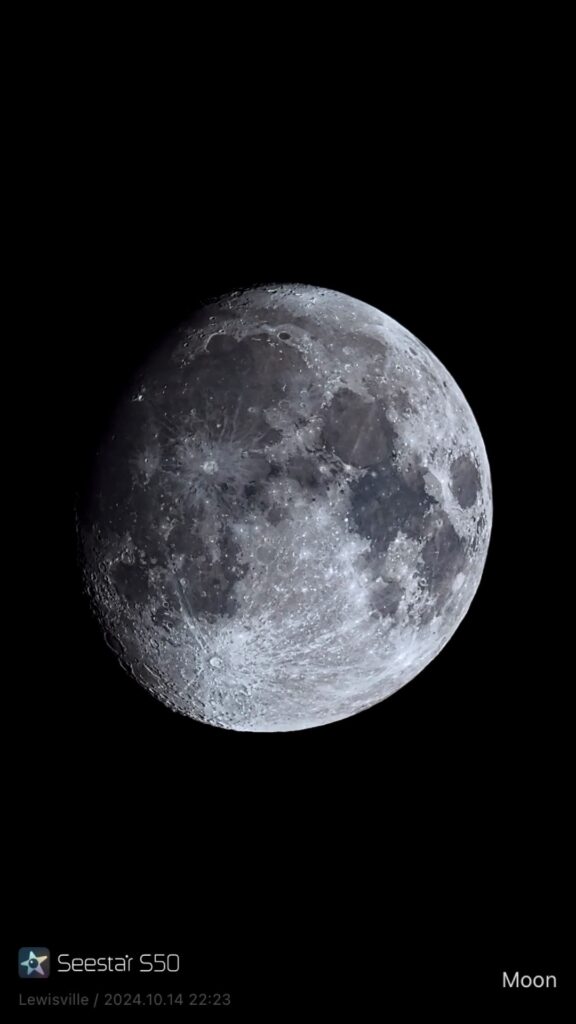

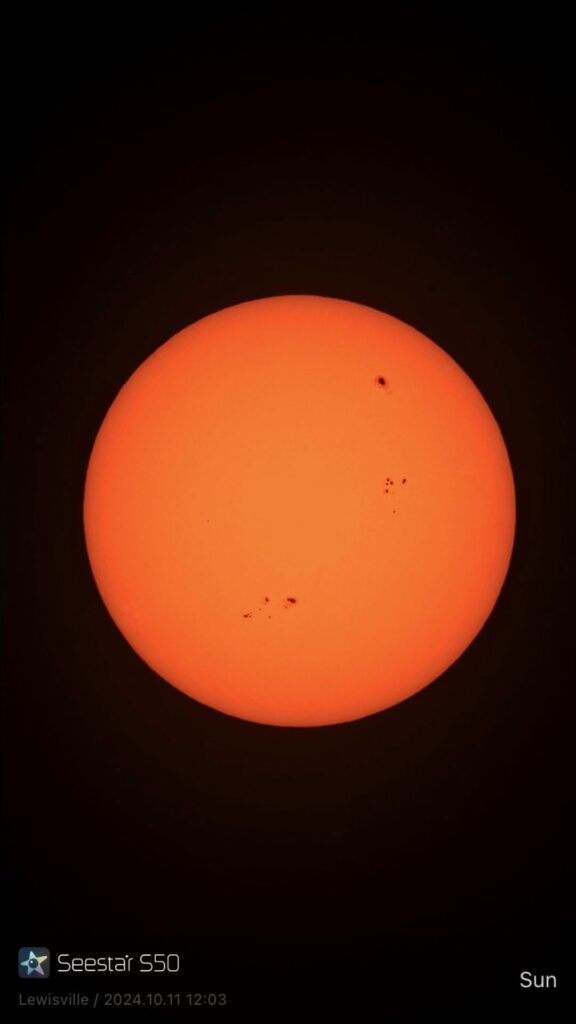


Seestar S50 images, re-stacked with AI denoise applied in the Seestar app.
Astrophotography Equipment
If you’d like to venture into more traditional astrophotography, you will find it to be more complicated, and, yes, more expensive. You will, in general, need the following equipment.
- Imaging telescope – the telescope used to view objects in the night sky. Suppliers such as Explorer Scientific, Askar, ZWO, and Williams Optics provide a wide range of refractor telescopes for astrophotography.
- Imaging telescope camera – a camera that will take your images. Typically deep-sky astrophotography is done with DSO cooled cameras such as those supplies by ZWO.
- Guide telescope – a smaller telescope used to guide your mount.
- Guide telescope camera – a smaller camera used to image a star for tracking.
- A mount with a tripod – something to mount your telescopes on. Several club members use the AM3N or AM5N harmonic mounts from ZWO.
- A control box – an interface for you to communicate to the mount. Several club members use the ASiair devices from ZWO.
- A power pack – most astrophotography setups require a DC battery. Look for one with a capacity of 500Wh and 5.5mm x 2.1mm DC barrel (DC 5521) ports.
The focal length and image size are two criteria to focus on. The longer the focal length, the more an object is magnified. The shorter the focal length, the wider the field of view.
Most dedicated astrophotography cameras use a CMOS (Complementary Metal Oxide Semiconductor) sensor rather than the more traditional CCD (Charge Coupled Device) sensor. Camera sensors also offer a range of image sizes from 1” in diameter to APS-C to Full Frame 35mm.
ZWO has combined the functionality of the main camera, guide camera, and control box into smart cameras, which can simplify your setup.
You can also use standard DSL cameras for astrophotography, although we won’t cover this option here. While refractors are typically used for deep-sky objects, reflectors are also an option, particularly for planetary imaging.

In many cases, optical elements can be added to your setup. For some telescopes, a flattener is a must.
- Flattener – corrects for the curvature in a refractor’s lens and smooths out the stars in the corners of your image.
- Reducer – reduces the focal length to increase the field of view and capture more light.
- Extender – extends the focal length to reduce the field of view and increase the magnification.
Your equipment requires the correct (55mm in many cases)back focus from the last optical element to the camera.
Filters will go a long way to enhance your images. Overall three types are available.
- UV/IR Cut Filters (aka Luminance Filters) cut out non visible (UV and IR) light and allow only visible light through.
- Broadband Filter cut out the effects of light pollution. These can be used for most deep-sky objects. Several members have the L-Pro or the newer L-Quad Enhanced from Optolong.
- Dual-Narrowband Filters captured wavelengths. Hα (656nm), OIII (500nm), and possibly SII (672nm), from emission (and planetary) nebulae. Several members have the L-eXtreme (10nm/24nm), L-Para (10nm), L-eXtreme (7nm), or L-Ultimate (3nm) filters with different bandwidths from Optolong.
Equipment typically cannot be found locally, but must be ordered online. Three well known retailers of astronomical equipment are High Point Scientific, Agena Astro, and Astronomics.
Image Processing
Your images are typically captured as FIT files. They are referred to as Lights. In most cases you will also take three sets of calibration frames (Flats, Darks, and Biases). Multiple images (subs) are taken of each deep-sky object and then stacked to produce the final image. When using a guide scope and camera, you can take 60 second to 3-4 minute images (Subs). Depending on the conditions, you might capture 1/2 hour to several hours worth of these images.
Capturing images is just the starting point. Processing images can also be a complex, although not nearly as expensive, process.
Developing a workflow for processing astrophotography images is one of the more difficult tasks. Each person has his/her own process and, for many, the process can change and evolve over time. You can find a very generic workflow here. In general, you will perform most, if not all of, these steps:
- Stack your subs along with your calibration frames to produces a single image.
- Crop your image to remove pixilation and other defects.
- Adjust the background to remove gradients.
- Perform a color calibration to “correct” the star colors.
- Sharpen the stars (deconvolution).
- Denoise the image to remove excess noise.
- Remove the stars, process the starless image, and later recombine it with the stars.
- Stretch the image to bring out faint details.
There is a multitude of software available for astrophotography. Many folks use one of three packages for their main processing: Siril, Astro Pixel Processor, or PixInsight, with PixInsight becoming the leading option. Other software such as Deep Sky Stacker, GraXpert, Cosmic Clarity, Starnet++, VeraLux, and RC astro plugins for PixInsight are useful.
More Informaion
You can find much more about astrophotography on FAS’s Astrophotography (A deeper dive) webpage. For astrophotography images see our FAS Member Astrophotography page.
YouTube is a great place to go for astrophotography information. Here are a few sources.
- AstroBackyard. Website.
- Deep Space Astro. Facebook.
- Cuiv, The Lazy Geek. Facebook.
- The Space Koala. Website. Facebook.
- Nazronomy.
A Few Astrophotography References
- Trevor Jones. “Deep-Sky Astrophotography How-To.” AstroBackyard. April 29, 2025.
- “Deep-Sky Astrophotography HOW-TO (Step-by-Step).” AstroBackyard/YouTube. October 7, 2023.
- Trevor Jones. “Beginner Astrophotography: How to Get Started.” AstroBackyard.
- “Introduction to Deep-Sky Astrophotography.” AstroBackyard. August 16, 2024.
- “Deep Sky Astrophotography Equipment.” AstroBackyard.
- “Beginner Astrophotography Gear: Best Telescopes, Mounts, & Cameras to Start With.” Agena Astro. January 22, 2026.
- Trevor Jones. “Best Astrophotography Telescopes (2025).” AstroBackyard. Updated July 10, 2025.
- Cierra Armijo. “Top Astrophotographers Cameras of 2025.” High Point Scientific.
- Trevor Jones. “Choosing an Astrophotography Camera.” AstroBackyard. Updated November 3, 2025.
- The Space Koala. “Build Your Own Smart Scope! Easy as a SeeStar, Pro results!” YouTube. July 6, 2025.
- “Photoshop vs Siril vs PixInsight Comparison.” Delta Astrophotography/YouTube. December 1, 2024.
- “80% of Astrophotography Basics in 20 Minutes!” AstroBackyard/YouTube. August 16, 2024.
- “Astrophotography: 14 MUST KNOW Starting Tips!” AstroBackyard/Youtube. December 16, 2022.
- “Beginner’s Guide to Deep Sky Objects: Essential Tips for Astrophotographers.” CosmicCaptures/YouTube. February 11, 2024.
Note that FAS does not specifically recommend or endorse specific astrophotography equipment, software, or suppliers. We merely provide information about products generally available and, in several cases, used by our members.
You must be logged in to post a comment.