

FAS Astronomers Blog, Volume 34, Number 4.
An Introduction to Globular Clusters
Globular Clusters (aka Globulars) are some of the more interesting objects viewed by amateur astronomers, although they do tend to the look the same. There are more than 150 of these visible in the Milky Way galaxy. The Andromeda galaxy does us one better with around 300. Galaxy M87 might have as many as 10,000 or more.
The first globular cluster was identified by Abraham Ihle back in 1665. One of the more well known, the great Hercules globular cluster, was initially classified by Edmond Halley of the comet fame, as a nebula in 1714. Later, William Herschel correctly reclassified it as a globular cluster. Charles Messier might have been the first to identify individual stars in a globular cluster in 1764 when he observed M4. The term globular cluster was first introduced by William Herschel in his 1789 Catalogue of a Second Thousand New Nebulae and Clusters of Stars. Beginning in 1914, Harlow Shapely mapped the rough distribution and distance to globular clusters in the halo of the Milky Way. Later, in 1918, Shapley used globular clusters to first estimate the shape of the Milky Way when he positioned the Earth off to the side rather than at the galactic center. (This paragraph was adapted from Wikipedia.)
Globular clusters are densely packed spheres of stars generally found in the halo of the Milky Way. They contain thousands to millions of stars and range in size up to a few hundred light years across. This compares to Open Star Clusters, which are found in the Milky Way’s disk, and are much smaller, more irregular, and contain much younger stars. The density near the center of a globular cluster can range from 100 to 1,000 stars per cubic parsec. A parsec is 3.26 light-years. As a comparison, there are only four stars (the three stars of the Alpha Centauri system and our Sun) in the 4 ¼ light-year sphere around the Sun.
One theory is that globular clusters developed during the early stage of galactic formation when a galaxy was mostly spherical and contained older “non-metallic” stars. Over time, the galaxy flattened out into a spiral while the globular clusters remained in a central sphere, which became the halo. Globular clusters could also be small ancient galaxies that were absorbed by larger galaxies. In July 2024, astronomers found evidence of an intermediate sized black hole at the center of Omega Centauri. There also may be black holes within M22.
Globular clusters, although spherical, can have a slightly different core density. In the 1920s, Harlow Shapely and Helen Sawyer developed a classification for this ranging from most concentrated (I) to least concentrated (XII).
Globulars are mostly collections of older (Population II) stars, which lack the “metals” found in younger stars like the Sun. Some date back close to the formation of the Milky Way around 12 to 13 billion years ago. Although, some have been found to contain younger/newer stars indicating that some limited stellar formation might still be going on.
Astronomers have also found “blue stragglers” within globular clusters. These are large stars probably resulting from stellar collisions or from binary stars where a star syphons off material from its partner. Older stars leave the so-called Herzsprung-Russell main sequence as they become larger, but redder (dimmer). Blue stragglers, however, tend to be bigger and bluer (brighter) than other stars of the same age and “stagger” behind the shift to a more reddish color.
Globular Clusters in the Night Sky
Of the 150 or so visible globular clusters, there are several that are prime targets for amateurs. Most are classified as Messier objects (those categorized by Charles Messier back in the eighteenth century) or Caldwell objects (the 109 brightest objects not included in Messier’s list).
The four most well-known are probably these below. All are relatively bright and have angular dimensions close to that of a full Moon (at ½ a degree or 30‘).
- The largest and brightest is Omega Centauri (NGC 5129 / C80), which is found in the constellation of Centaurus. With an apparent magnitude of +3.9 and apparent diameter of 36’, it contains around 10 million stars and is some 15,800 light years away. Its Shapley-Swayer classification is VIII indicating it is somewhat loosely bound. Unfortunately, it is primarily visible from the southern hemisphere and can be seen from our latitude only for a short time in the spring well below the star Spica.
- The most massive globular cluster might be 47 Tucanae (NGC 104 / C106) with millions of stars. Closer than Omega Centauri at 14,500 light years, it has a visible magnitude of +4.1 with an apparent diameter of 43.8’. It is much more tightly bound with a Shapley-Swayer classification of III. It is visible only from the southern hemisphere in the constellation Tucana near the Small Magellanic Cloud.
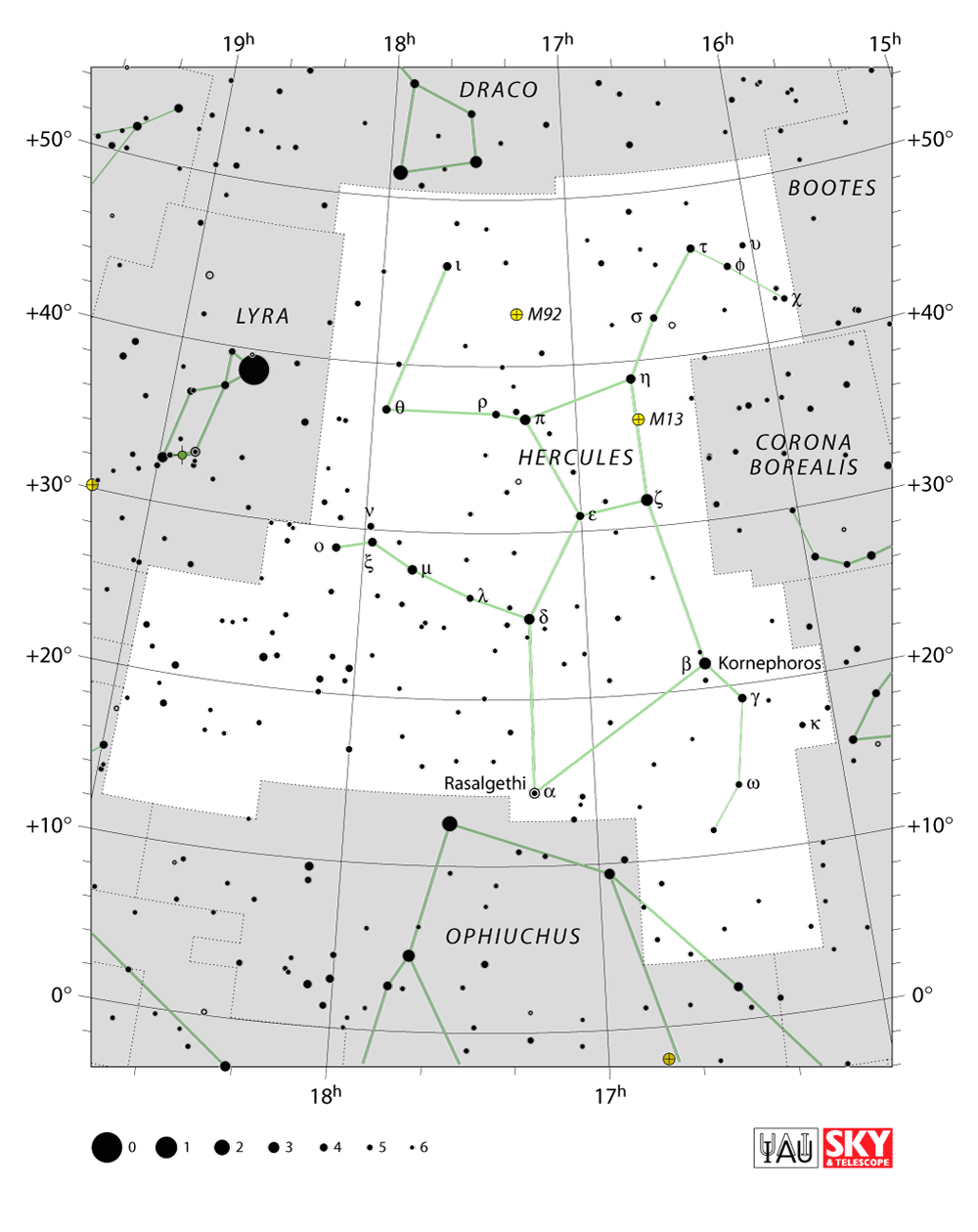
- The best-known globular cluster visible from the northern hemisphere is the Great Globular Cluster in Hercules (M13). At around 22 to 25 thousand light years away with 300,000 stars, it has an apparent magnitude of +5.8 and angular dimension of 20’. It is a medium bound globular with a Shapley-Sawer classification of V. If you’re just starting out, go here first. Because it is high in the sky, it is one of the easiest deep-sky objects to find and view. Find it a third of the way down on the right side of the Keystone below Hercules’ bending knee (provided Hercules is upside down as in the IAU diagram.)
- The brightest globular cluster visible from the Northern Hemisphere, with an apparent magnitude of +5.1, is the Sagittarius Cluster (M22) located above the lid of the Sagittarius “teapot.” It is relatively close at 10,600 light years away giving it an angular size of 32’. It is more loosely bound than M13 with a VII Shapley-Sawer classification. It is not quite as well-known as M13 probably because it is usually found near the horizon.




NGC 5193, M22, and M13 (Seestar S50 Image Credits: Bill Rankin and Bruce Gavett). M13 (Askar V Image)
In the spring and early summer, Messier 3, 4, and 5 are good targets for viewing. M92 in Hercules might be another good early summer target. Later in the fall, you might search for M2 and M15.
- M3 is found between Boötes and Coma Berenices in the constellation of Canes Venatici. It has ½ million stars with an apparent magnitude of +6.2. Its distance of almost 34,000 light-years away results in a small apparent diameter of 18’. It has a medium bound core of VI on the Shapley-Sawer scale.
- M4 with 20,000 stars, is the closest globular cluster to the Earth at only 7,200 light-years away. Its close distance results in an apparent magnitude of +5.9 and an angular dimension of 26’. It is a very loosely bound globular, with a Shapley-Sawer IX classification, and looks more like an open cluster than a globular cluster through a telescope. It is found next to the star Antares in Scorpius.
- Globular Cluster M5 is found in the constellation of Serpens between Boötes and Scorpius. At 24,500 light years aways, it has an apparent magnitude of +6.65 and angular width of 23’. It’s Shapley-Sawyer classification is V.
- M92 is also in the constellation Hercules but is not nearly as well known as M13. It is fainter with a +6.3 magnitude and a 14’ angular diameter. It is 26,700 light years away and somewhat densely bound with an IV Shapley-Sawer classification.
- High in the constellation Aquarius is M2. It is a relatively bright globular with a +6.3 magnitude and 16’ angular displacement. It is a distant 37,500 light years away. It contains 150,000 stars, is 150 light years across, and is very tightly bound with a II Shapley-Sawyer classification.
- The Great Pegasus Cluster (M15) is found off the star Enif, which is the end of the nose of Pegasus. At 33,600 light years away, it has an apparent magnitude of +6.2 and 18’ angular width. It is somewhat densely bound with an IV Shapley-Sawer classification.
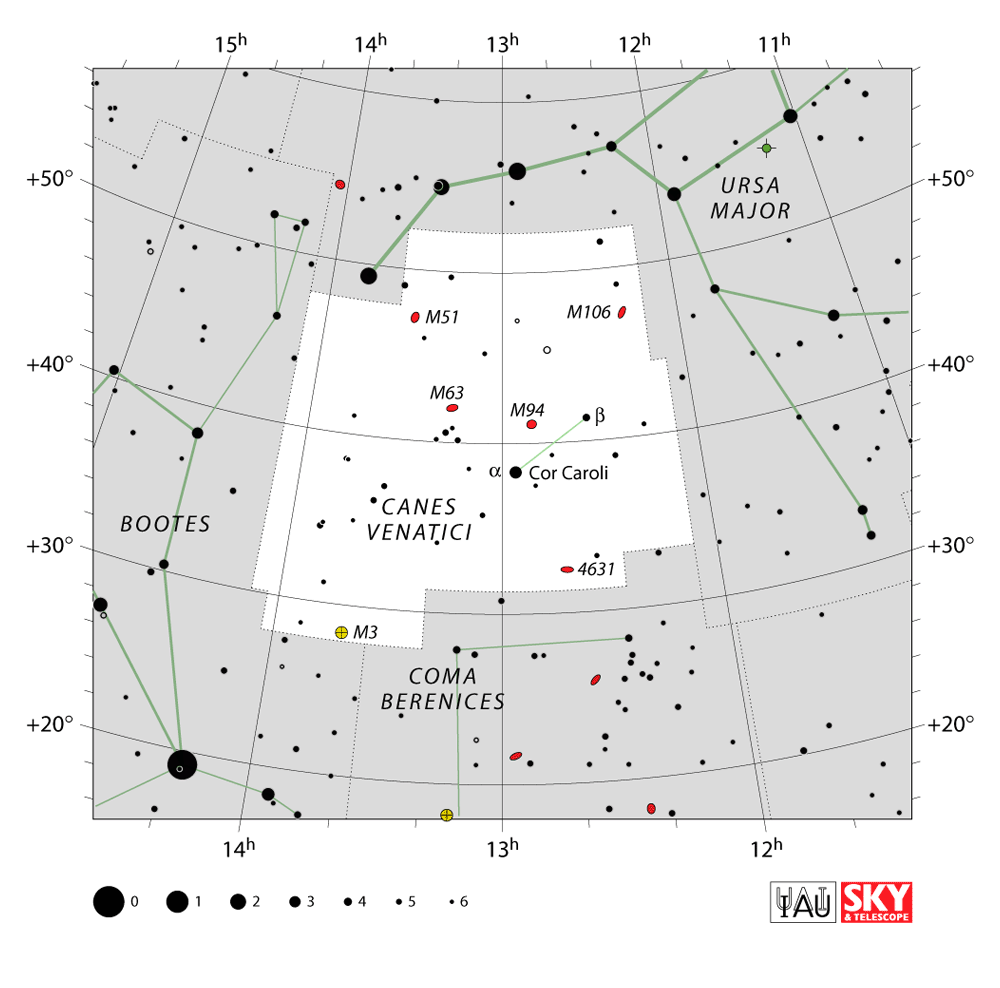


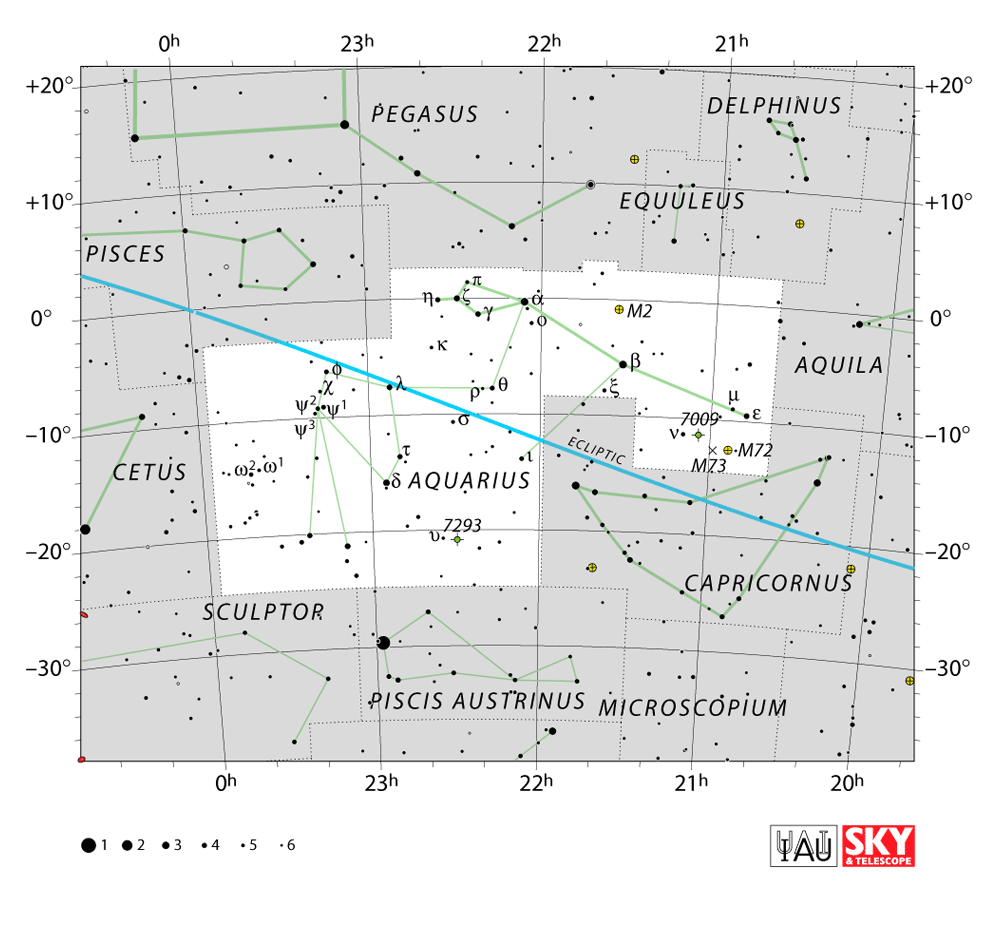


M3, M5, M92, M2, and M15
The biggest trove of globular clusters is found during the summer in the constellations of Ophiuchus and Sagittarius. Here are several that you might search for.
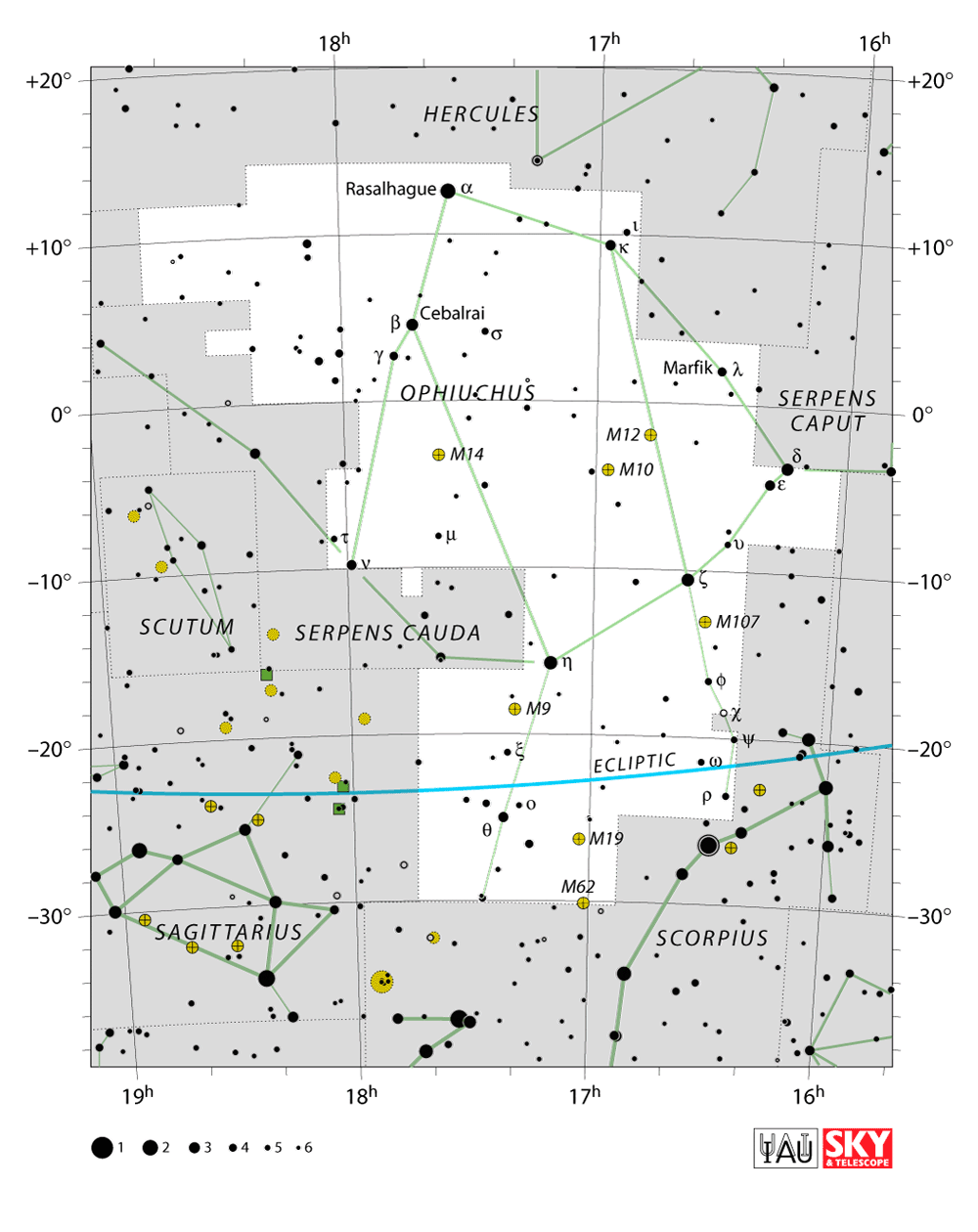
- M10 is the brightest of many globular clusters found in Ophiuchus due to its 14,300 light year distance. However, it is still dimmer than some of the others found elsewhere with a magnitude of +6.4 and a 20’ angular diameter. It is also loosely bound with a VII Shapley-Sawer classification.
- M12 (the Gumball Cluster) is close by M10 in the middle of Ophiuchus. At 15,700 light years away, it has a magnitude of +7.7 and angular diameter of 16’. It is very unbounded with an IX Shapley-Sawyer classification.
- M62 is found lower in Ophiuchus. At 22,200 light years from Earth, it has a +7.4 magnitude and 15’ angular diameter. It is very tightly bound with an IV Shapley-Sawer classification.
- M28 is a fainter companion to M22 near the top of the Sagittarius teapot. It has an apparent magnitude of +7.7 and angular diameter of 11’. It is a densely bound globular 17,900 light years away with an IV Shapley-Sawer classification.
- M55 (Summer Rose Star) is located 17,600 light years away in Sagittarius. It is a very loosely bound globular with a XI Shapley-Sawyer classification, +7.4 apparent magnitude, and 19’ angular diameter.
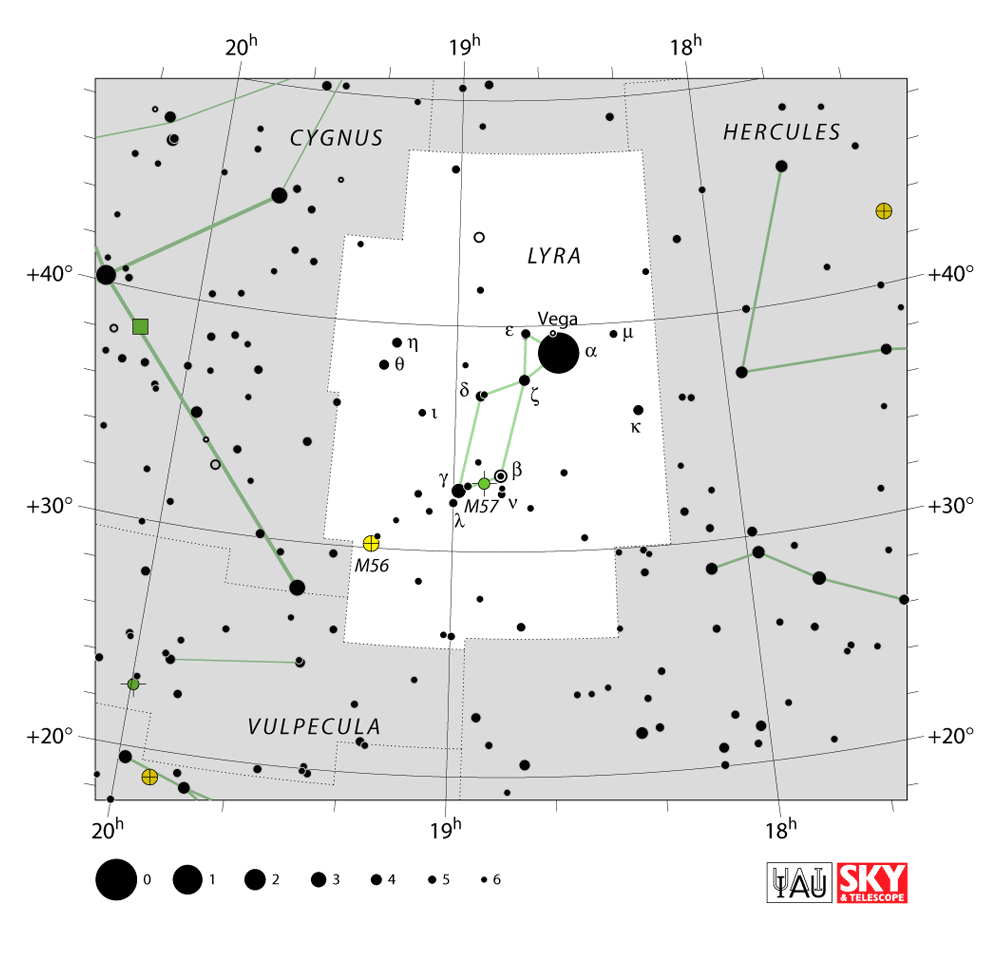
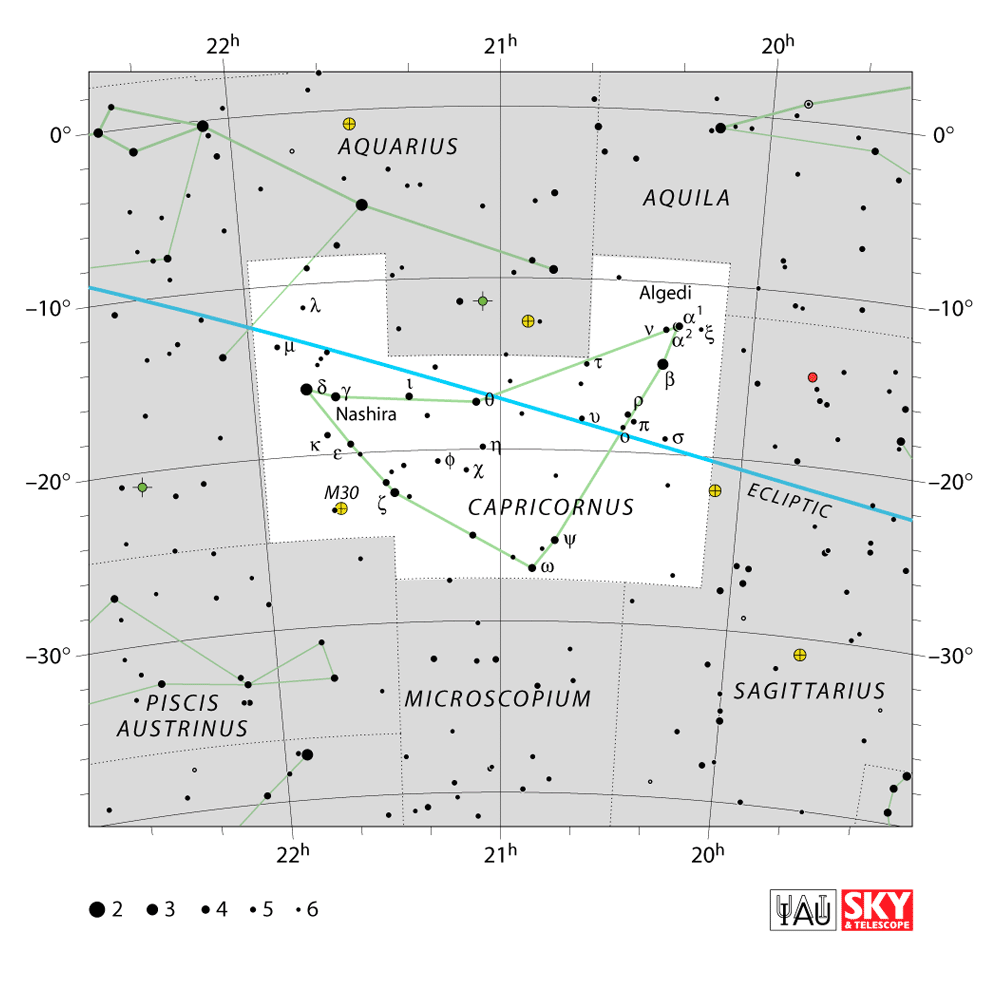
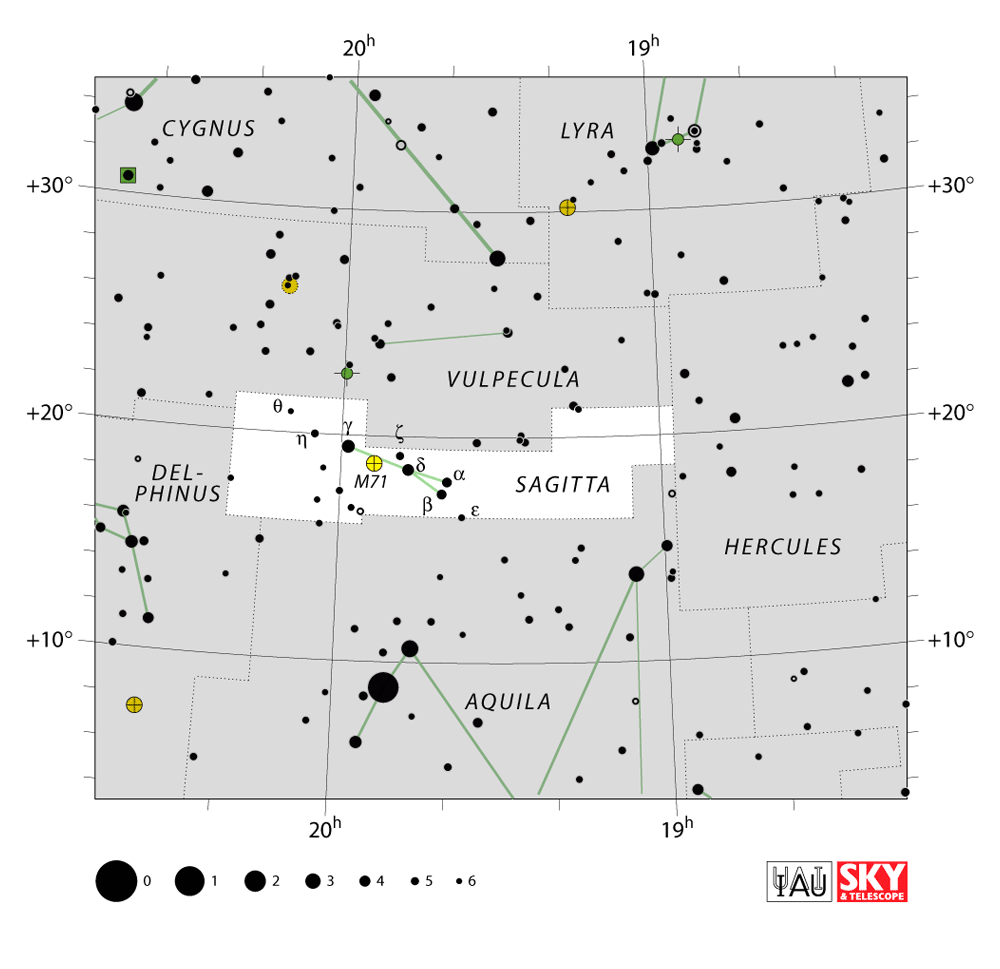
There are a few others you might try and locate including M56 in Lyra, M30 in Capricornus, M71 in Sagitta, and M53 in Coma Berenices.


M10, M12, M26, M53, and M56
If you’d like a challenge, the Astronomical League offers a Globular Cluster Observing Program.
Observers select a minimum of any 50 globular clusters from the list of 190 cataloged in the Guide. This allows for the customization of an observing list suitable to the individual observer’s interests, skies, and equipment. However, this program is more than just observing 50 globular clusters and recording your observations. This program requires both visual and imaging observers to determine the Shapley-Sawyer concentration class of each globular cluster observed. (Astronomical League)
Below, for those of us in the northern hemisphere, is a limited list of the Messier globular clusters by constellation.
- Coma Berenices: M53.
- Hydra: M68.
- Serpens: M5.
- Hercules: M13 and M92.
- Scorpius: M4 and M80.
- Ophiuchus: M10, M12, and M14 (middle), M9, M19, M62, and M107 (lower).
- Sagittarius: M22 and M28 (above the teapot). M54, M69, and M70 (at the base of the teapot), M55, and M75 (below and left of the teapot).
- Lyra: M56.
- Sagitta: M7 and M71.
- Capricornus: M30.
- Aquarius: M72.
- Pegasus: M15.
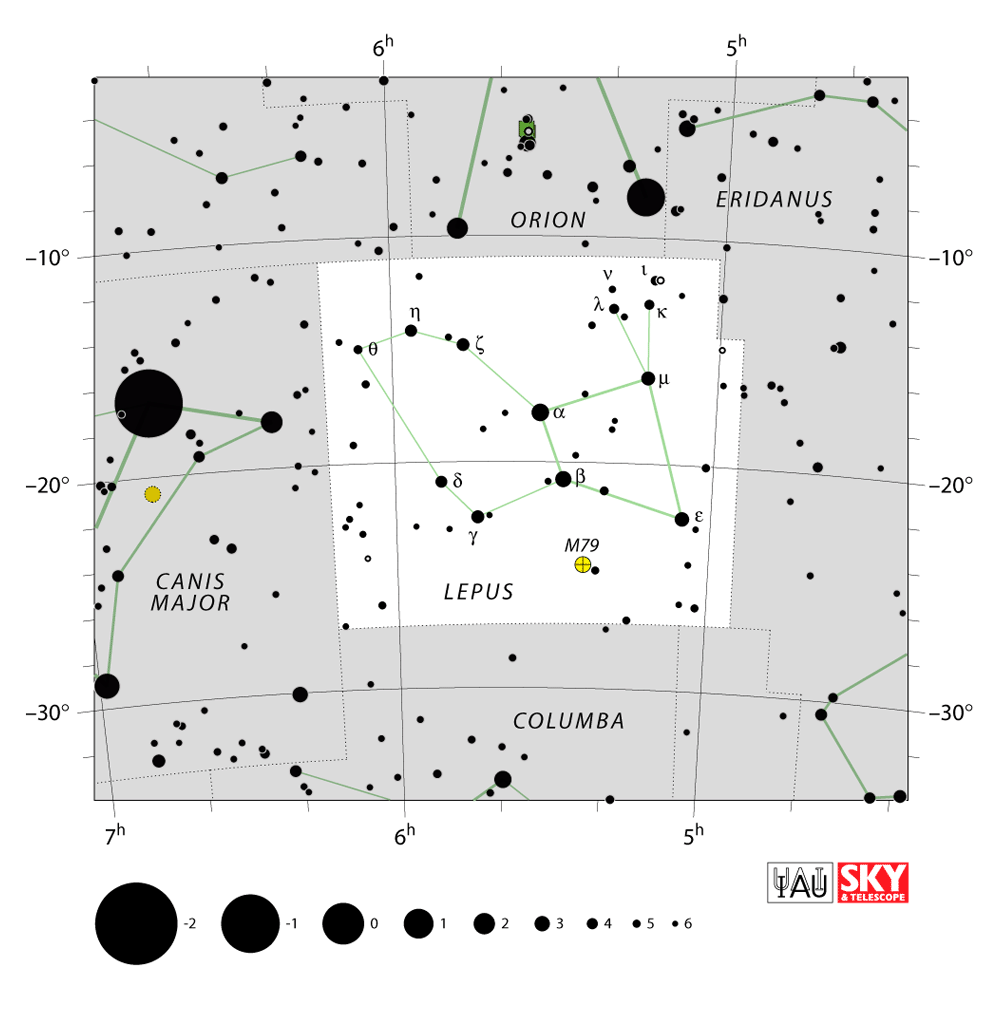
- Lepus: M79.
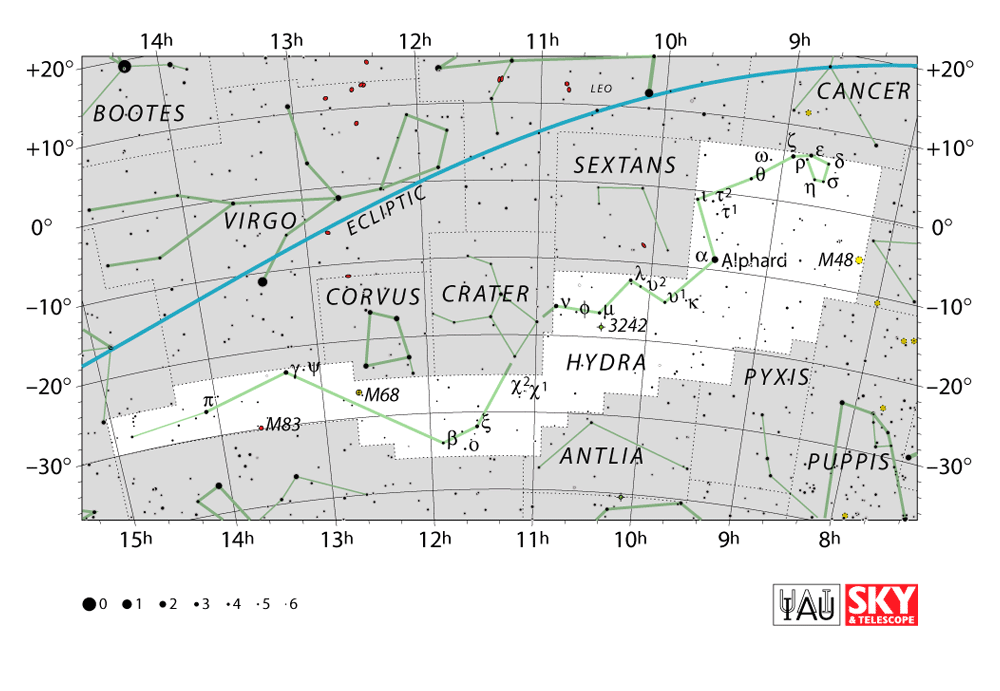
Much of the information on individual globular clusters is from Messier Objects. Many of the images above were taken with a ZWO Seestar S50, ASI585, or ASI2600 camera. They were processed using Siril (C. Richard et al., Journal of Open Source Software, 2024, 9(102), 7242. DOI: 10.21105/joss.07242), GraXpert, Seti Astro Cosmic Clarity sharpening and denoise, and VeraLux Hypermetric Stretch. See our Introduction to Astrophotography for more information.
Image Processing for Globular Clusters
For those who are astrophotographers, globular clusters can be a challenge to process. There are, of course, stars, and it is difficult to capture the surrounding stars and, at the same, time the stars near the core of the cluster. Most of the time the core becomes over saturated and looks like a bright blob.
Rich from Deep Space Astro has a video with suggestions for those who use Siril. However, the video is a couple of years old and utilizes an older version of Siril. GraXpert is now fully integrated with Siril and Star deconvolution can be done with scripts. The video does have an interesting approach, which is to use Starnet++ to remove the stars. Then, focus on the star master and disregard the starless image. The video utilizes the General Hyperbolic Stretch (GHS), however, you might be able to use other stretching techniques. We’re working through this to see if it really works.
One of our members asked an AI bot and came up with this below. Although, we’re also working through this approach to see if it really works.
The best stretching routine for globular clusters in PixInsight focuses on a single golden rule: resolving individual stars all the way into the core without letting the core blow out into a solid white blob. Because globular clusters consist of a high-dynamic-range (HDR) core surrounded by faint outer halos, traditional global stretches like Screen Transfer Function (STF) applied to HistogramTransformation will immediately overexpose the center. The absolute gold standard workflow uses Generalized Hyperbolic Stretch (GHS), though modern automated scripts provide excellent, faster alternatives.
Generalized Hyperbolic Stretch (GHS) allows you to choose an exact brightness level (Symmetry Point) to stretch, meaning you can pull up the dim outer stars while deliberately protecting the bright core from saturating.
- Step 1: The Initial Arcsinh Stretch (Color Protection)
Before jumping into a heavy stretch, run a very mild ArcsinhStretch or use the GHS tool in Arcsinh mode. This step safely elevates the base signal while locking in and boosting the natural star colors (old orange giants and young blue stars) before they can wash out into white.- Step 2: Locate the Main Core Profile
Open the GHS process, view the real-time preview, and use the picker tool to click on the outer edge of the cluster’s core (the region just before it gets blindingly bright). This sets your Symmetry Point (SP).- Step 3: The Primary GHS Stretch
Set the stretch mode to GHS. Slowly increase the Local Stretch Factor (b) and the Stretch factor. You will see the background sky and the faint peripheral stars lift, but the core will remain tightly controlled. Apply this stretch.- Step 4: The Core and Background Tweak
Now, pick an SP right in the center of the dense core. Apply a very low stretch factor with a high factor (protect highlights) to gently blend the core brightness without clipping it. Finish by adjusting the black point slider inside GHS to set your background sky to a natural, dark gray (never pure pitch black).
Selected Sources and Further Reading
- Trevor Jones. “What is a Globular Cluster?” AstroBackyard.
- Andy Briggs. “What’s a globular cluster? The Milky Way has about 150.” EarthSky. August 16, 2024.
- Ron Brecher. “Globular clusters: what they are and the best ones to observe.” BBC Sky At Night Magazine. May 10, 2021.
- Conor Feehly. “What Are Globular Clusters?” space.com. April 17, 2024.
- “Stellar Populations Of Globular Clusters.” COSMOS – The SAO Encyclopedia of Astronomy. Swinburne University of Technology. Centre for Astrophysics and Supercomputing.
- Richard Bartlett. “What is a Globular Cluster and Which Ones Are Best.” High Point Scientific. February 22, 2023.
- Mark Armstrong. “A guide to globular clusters.” Astronomy Now. May 13, 2013.
- Stephen James O’Meara. “Tackle a globular cluster showdown.” Astronomy. July 18, 2019.
- “The Brightest Globular Clusters in the Sky.” In-The-Sky.org.
- Wikipedia contributors. “Globular cluster.” Wikipedia, The Free Encyclopedia. Wikipedia, The Free Encyclopedia, 16 Aug. 2024. Web. 27 Sep. 2024.
- Trevor Jones. “The Great Globular Cluster in Hercules.” AstroBackYard.
- Bruce McClure and Don Machholz. “Meet M13, the Great Cluster in Hercules.” EarthSky. April 30, 2022.
- Phil Plait. “A Globular Cluster for the New Year: M22.” SkFy Wire/Bad Astronomy. December 15, 2019.
- Bruce McClure. “M5, Your new favorite globular star cluster.” EarthSky. June 20, 2023.
- “Messier 92.” NASA Science.
- “Evidence for intermediate-mass black hole in Omega Centauri.” EarthSky. July 18, 2024.
- “Hubble finds strong evidence for intermediate-mass black hole in Omega Centauri.” ESA. heic2409 — Science Release. July 10, 2024.
- “Hubble finds strong evidence for intermediate-mass black hole in Omega Centauri.” ESA. heic2409 — Science Release. July 10, 2024.
- Evan Gough. “Mysterious No More: Astronomers Used The Hubble To Solve The Blue Straggler Problem.” Universe Today. January 22, 2026.
- “Globular Cluster Observing Program.” Astronomical League.
- “Messier Objects.” Messier Objects.
- “Caldwell Catalogue.” Constellation Guide.
- “Hubble’s Messier Catalog.” NASA Science.
- “Hubble’s Caldwell Catalog.” NASA.
- “Objects In the Night Sky.” In-The-Sky.org.
- “Deep-Sky Objects.” FAS Website.
- “The Deep Sky.” FAS Astronomers Blog. June 2022.
- C. Richard et al., Journal of Open Source Software, 2024, 9(102), 7242. DOI: 10.21105/joss.07242.
Selected Sources and Further Viewing
- Phil Plait. “Introduction to Star Clusters.” Crash Course in Astronomy #35/YouTube. October 8, 2015.
- “Globular Clusters: Stellar Pockets.” NASA/YouTube. December 1, 2022.
- “What Are Globular Clusters? Relics of the Early Universe.” Fraser Cain/YouTube. September 12, 2017.
- “Unveil the Beauty of Globular Clusters: Siril Processing Tutorial.” Deep Space Astro/YouTube. August 9, 2024.
Selected Sources and Further Reading (Specific Globular Clusters)
- “Omega Centauri (NGC 5139).” Constellation Guide. June 2, 2023.
- “47 Tucanae.” Constellation Guide. November 12, 2023.
- “Messier 13: Hercules Globular Cluster.” Messier Objects. March 31, 2015.
- “Messier 22: Sagittarius Cluster.” Messier Objects. April 15, 2015.
- “Messier 3.” Messier Objects. January 26, 2015.
- “Messier 4.” Messier Objects. January 31, 2015.
- “Messier 5.” Messier Objects. January 31, 2015.
- “Messier 92.” Messier Objects. August 15, 2015.
- “Messier 2.” Messier Objects. January 17, 2015.
- “Messier 15: Great Pegasus Cluster.” Messier Objects. April 5, 2015.
- “Messier 28.” Messier Objects. April 22, 2015.
- “Messier 54.” Messier Objects. June 10, 2015.
- “Messier 55: Summer Rose Star.” Messier Objects. June 11, 2015.
- “Messier 69.” Messier Objects. July 14, 2015.
- “Messier 70.” Messier Objects. July 14, 2015.
- “Messier 75.” Messier Objects. July 24, 2015.
- “Messier 9.” Messier Objects. February 20, 2015.
- “Messier 10.” Messier Objects. March 10, 2015.
- “Messier 12.” Messier Objects. March 11, 2015.
- “Messier 14.” Messier Objects. March 31, 2015
- “Messier 19.” Messier Objects. April 6, 2015.
- “Messier 62.” Messier Objects. July 2, 2015.
- “Messier 107.” Messier Objects. September 16, 2015.
- “Messier 30.” Messier Objects. April 22, 2015.
- “Messier 53.” Messier Objects. June 10, 2015.
- “Messier 56.” Messier Objects. June 11, 2015.
- “Messier 68.” Messier Objects. July 14, 2015.
- “Messier 71.” Messier Objects. July 24, 2015.
- “Messier 72.” Messier Objects. July 24, 2015.
- “Messier 79.” Messier Objects. August 2, 2015.
- “Messier 80.” Messier Objects. August 2, 2015.
Technical Reading
- Maximilian Häberle et al. “Fast-moving stars around an intermediate-mass black hole in ω Centauri.” Nature. Volume 631. Pages 285–288. July 10, 2024.
- Francesco R. Ferraro, Barbara Lanzoni, Enrico Vesperini, et al. “A binary-related origin mediated by environmental conditions for blue straggler stars.” Nature Communications. Volume 17. Article number: 768. 2026.
For more articles like this see:
You must be logged in to post a comment.