

FAS Astronomers Blog, Volume 33, Number 7.
Other than the Earth, the best-known planet in our Solar System is probably Mars. However, it isn’t a very large planet – only around ½ the width of the Earth. It also isn’t a great view through a small telescope – very little detail is evident. If you’re lucky, you might see one of the polar ice caps, but usually it is just a small fuzzy red ball.
But Mars is reasonably close, and it has a thin atmosphere with a rocky surface. This is a planet we can explore with our orbiters and landers. For more on the exploration of Mars, see Journey to a Red Planet and Exploring Mars, Past and Present.

Mars is the fourth planet from the Sun. It is 1½ times farther from the Sun than the Earth at an average distance of 142 million miles. Unlike the Earth, it has a slightly elliptical orbit (5 ½ times that of the Earth), which takes it as close as 128 million miles from the Sun (perihelion) and as far as 155 million miles from the Sun (aphelion).
Mars takes 687 days (just under two years) to complete one orbit about the Sun. Therefore, the Earth and Mars line up in what we call opposition around every two years. This is the optimal time to send spacecraft to Mars. In 2003, Mars had one of its closest oppositions when it was less than 35 million miles from the Earth. This was the closest approach in 60,000 years. Mars won’t be this close to the Earth again until 2287 (mark it on your calendar). Mars had a more distant opposition in 2012 when it was over 62 million miles away. Mars also lines up on the other side of the Sun every two years or so. This is called a conjunction when Mars is over 100 million miles away. See Planetary Opposition and Conjunction for more about all this.
Mars is a bit small as planets go. It is around half the width of the Earth at 4,220 miles and is only 10% as massive. A day on Mars is just slightly longer than a day here on the Earth at around 24 ½ hours. Mars is similar to the Earth with a rocky surface, and it does have season due to its 25.2o tilt in its axis. However, unlike the Earth, which has a very stable tilt, the tilt of Mars has varied considerably over the past few billion years.

Unlike the Earth, which has one large moon, Mars has only two very small moons (Phobos and Deimos). Both were discovered by Asaph Hall in 1877 and are thought to be captured asteroids. Hall named them after the sons of the Greek god Ares (Mars). Phobos is the god of fear and Deimos the god of dread.
Phobos is the largest and closest to the Martian surface. Its orbit is so fast that it beats Mars’ rotation and rises in the west and sets in the east. Someday it will crash into the surface. Deimos is smaller and much higher. It will someday escape the gravitational pull of Mars and return to being just another asteroid orbiting the Sun.


Today, Mars is cold and dry with a very thin atmosphere of carbon dioxide. The surface temperature ranges from a chilly -225 degrees up to the mid 60s. However, landers and rovers have been exploring the surface of Mars for many years. They’ve discovered that Mars, unlike current conditions, was once a wetter and warmer planet. There is ample evidence that liquid water flowed over its surface and much of that water is now trapped under the surface as water ice.
You may have noticed that Mars is red. Yes, it is called the red planet and is named after the Roman god
of war. But why is it red? Mars has iron material in its soil that has oxidized (we call it rust) giving the surface and atmosphere a red (or rusty) color. However, where did the rust come from? Mars is a very dry world with little or no water (except maybe frozen under its surface.)
For a long time, scientists thought the rust on Mars was something called hematite, which can form in dry conditions – much like seen on Mars today. Just recently a February 2025 study suggests that Martian rust is more Ferrihydrite, which is formed with water. This leads to the conclusion that Mars’ rust is very old and a remnant from a time when Mars was much warmer and wetter than it is today.
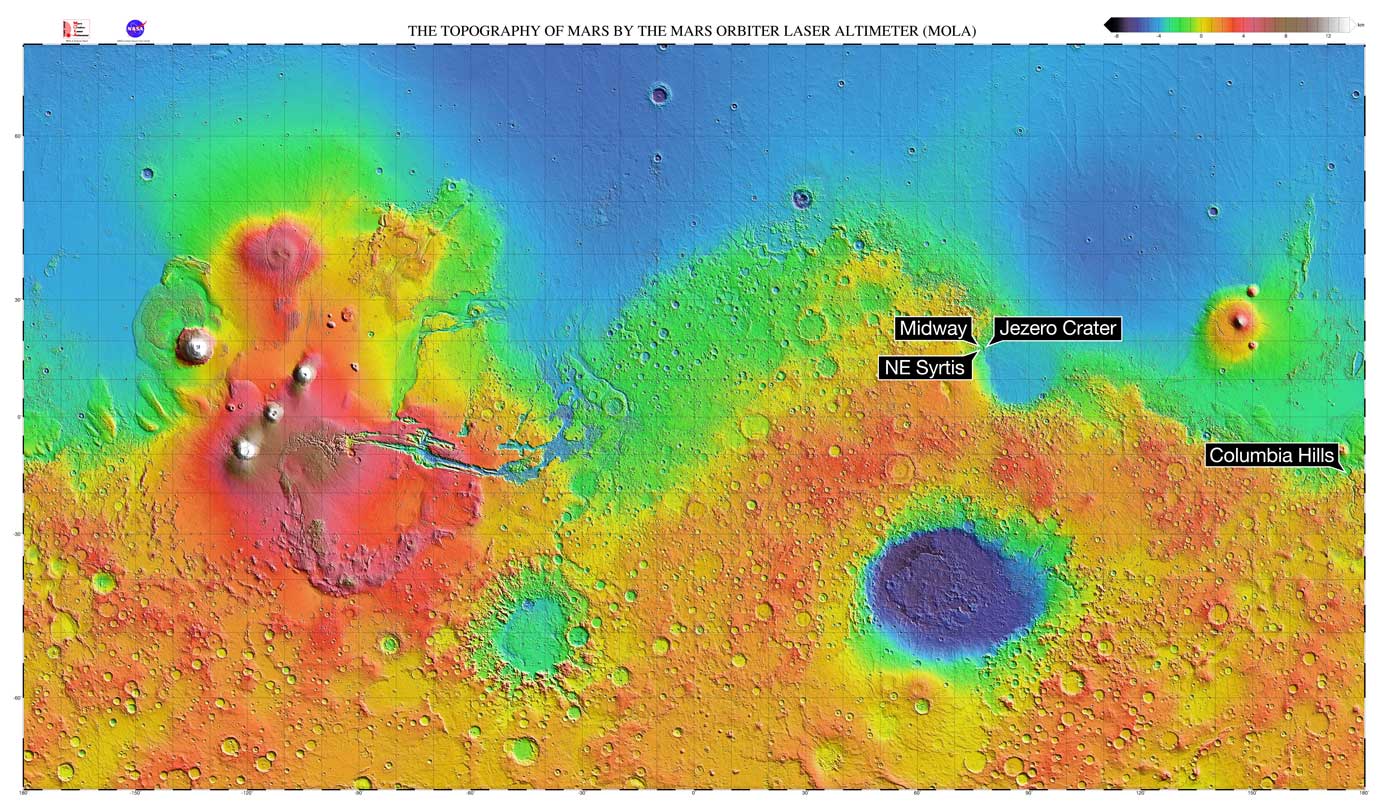
The Martian surface has several interesting features. In general, the northern hemisphere is much lower in altitude and smoother than the southern hemisphere.

When the first spacecraft (Mariner 4) passed close by Mars in 1965, it took 21 grainy black and white photos. At the time, scientists were hoping to see a planet much like the Earth – although colder and drier. Instead, the images showed craters. This view of the red planet was very moon like rather than Earth like. Fortunately, as other spacecraft were set to Mars, we discovered the planet was much more interesting than initially thought.
Mars does have craters, and the largest is Hellas Basin in the southern hemisphere. It is around 1,400 miles wide and is thought to have formed from the impact of a large asteroid some 4 billion years ago during the Late Heavy Bombardment. It also represents the lowest elevation on the planet.
Ancient volcanoes can be found on Mars. Three of these volcanoes are lined up in in what is known as the Tharsis region. Just to the northwest is the largest volcano in the Solar System, Olympus Mons. It is so massive that it would cover the state of Arizona. These volcanos grew much larger than terrestrial volcanos because Mars lacks the tectonic plates found here on the Earth. The Earth’s crust moves spreading volcanos out along a line. We see this with the islands of Hawaii. The crust on Mars just sits there allowing volcanos to build up on top of themselves over a long period of time.

There is a huge crack in the surface of Mars. It was discovered by the Mariner 9 spacecraft in 1971 and named Valles Marineris after the spacecraft. At 2,500 to 3,000 miles long, it would stretch across the entire United States and the Grand Canyon would fit into one of its side channels.

Mars does have polar ice caps – similar to what we see on the Earth. The thin surface layer is composed of carbon dioxide ice that sublimates (turns from a solid to a gas) during the spring and summer. This exposes a permanent layer of water ice. The top layer reforms later during the Martian fall and winter.

Mars does NOT have a face on its surface. You may have seen this photo taken by one of the Viking orbiters back in the 1970s.

After all the great images of huge mountains and vast canyons, this is the one photo that many people remember. It was taken by the Viking 1 orbiter when it focused on the Cydonia region. The folks at JPL referred to it as resembling a “human head”. Oops. This photo soon became known as the “Face on Mars”. Many thought this so called “face” was an artificial object – maybe even built by aliens. So, controversies raged. It would be 20 years before we really found out what the face was. And it was … a big rock. Sorry, no aliens.

So, everyone is happy now … there is no face on Mars.

Selected Sources and Further Reading (Mars in General)
- “All About Mars.” NASA Space Place.
- “Mars.” NASA Science.
- “Mars Facts.” Mars Facts.
- “Mars Facts.” The Nine Planets.
- “Mars, the red planet.” The Planetary Society.
- Dr. David R. Williams. “Mars Fact Sheet.” NASA Goddard Space Flight Center. Updated November 25, 2020.
- “Phobos.” NASA Science, Solar System Exploration. Updated December 19, 2019.
- “Deimos.” NASA Science, Solar System Exploration. Updated December 19, 2019.
- “Journey to a Red Planet.” FAS Astronomers Blog.
- “Exploring Mars, Past and Present.” FAS Astronomers Blog.
Selected Videos and Further Viewing
- “Mars in a Minute.” NASA/YouTube.
- “Explore the Surface of Mars in 360°” American Museum of Natural History/YouTube. February 28, 2025.
- “Mars 101 | National Geographic.” National Geographic/YouTube. May 31, 2018.
- “Magnificent Mars: 10 Years of Mars Reconnaissance Orbiter.” NASA Jet Propulsion Laboratory/YouTube. March 9, 2016.
- “Curiosity’s Seven Minutes of Terror.” NASA/JPL-Caltech. June 22, 2012.
- “Perseverance Rover’s Descent and Touchdown on Mars (Official NASA Video).” NASA/YouTube. February 22, 2021.
- “NASA unveils stunning new video of Mars landing.” ABC News. February 22, 2021.
- “Ingenuity Mars Helicopter Celebrates 50 Flights.” NASA/Jet Propulsion Laboratory/YouTube. April 13, 2023.
Selected Sources and Further Reading (Mars Opposition)
- “Mars at opposition 2025: Best time to see Mars.” Space & Telescope. January 18, 2025.
- Dominic Ford. “Mars at Opposition.” In-The-Sky.org.
- Bruce McClure. “The cycle of close and far Martian oppositions.” EarthSky. October 6, 2020.
- Marcy Curran. “Charts Showing Mars Oppositions from 2018 to 2033.” EarthSky. December 31, 2023.
- Matt Williams. “When will Mars be close to Earth?” Phys.org. April 10, 2017. Reprinted from Universe Today.
- “Mars Oppositions.”, 2012 to 2027. The Naked Eye Planets.
Selected Sources and Further Reading (Martian Topography)
- “Maps of Mars Global Topography.” NASA/JPL-Caltech.
- “Topographical map of Mars.” NASA.
- “Topographical map of Mars. The Planetary Society.
Selected Sources and Further Reading (Why Mars is Red)
- “Have we been wrong about why Mars is red?” ESA. February 25, 2025.
- William Steigerwald. “NASA: New Study on Why Mars is Red Supports Potentially Habitable Past.” NASA. February 25, 2025.
- Laura Baisas. “Why is Mars red? Our old understanding might be wrong.” Popular Mechanics. February 25, 2025.
- “Why is Mars red? Scientists may finally have the answer.” News from Brown University.
- Adomas Valantinas, John F. Mustard, Vincent Chevrier, “Detection of ferrihydrite in Martian red dust records ancient cold and wet conditions on Mars.” Nature Communications. Volume 16. Article number 1712. February 25, 2025.
- Fraser Cain. “Why is Mars Red?” Universe Today. October 21, 2013.
- Natalie Wolchover. “Why is Mars Red?” Space.com. August 8, 2012.
- Mark Peplow. “How Mars got its rust.” Nature. May 6, 2004.
- Brendan Koerner. “Why is Mars Red?” Slate Magazine. January 12, 2004.
- David Tytell. “Rusting Mars Without Water.” Sky & Telescope. September 4, 2003.
Selected Sources and Further Reading (Polar Ice Caps)
- “Polar Caps.” Mars Education at Arizona State University.
- “Northern Ice Cap of Mars.” NASA Science, Mars Exploration Program. Mary 26, 2010. Credit: NASA/JPL-MSSS.
- “Mars’ Southern Polar Cap.” NASA. NASA. May 12, 2005.
Selected Sources and Further Reading (Volcanos)
- “Tharsis Volcano.” NASA Science, Mars Exploration Program. June 8, 1998.
- Eric Betz. “Olympus Mons: Mars’ Mega Volcano.” Discover. November 5, 2020.
- Nola Taylor Redd. “Olympus Mons: Giant Mountain of Mars.” Space.com. December 9, 2017.
Selected Sources and Further Reading (Valles Marineras)
- “Valles Marineris: The Grand Canyon of Mars.” NASA Science, Share The Science. May 24, 2020.
- “Valles Marineris – The Grand Canyon of Mars.” USGS
- “Valles Marineris: The Grand Canyon of Mars.” NASA, Viking.
- “Valles Marineris. NASA’s Mars Exploration Program.
- Nola Taylor Redd. “Valles Marineris: Facts About the Grand Canyon of Mars.” Space.com. December 9, 2017.
- Jason Major. “Valles Marineris: The Grandest Canyon of All.” Universe Today. October 22, 2012.
Selected Source and Further Reading (The Martian Past)
- “Why Do We Care About Water on Mars?” NASA Science, Space Place.
- Charles Q. Chol. “Water on Mars: The Story So Far.” Astrobiology at NASA, Life in the Universe. October 14, 2016.
- “Mars’ Ancient Ocean.” NASA/Goddard Scientific Visualization Studios. March 5, 2015.
- “Mars present-day to 4.5 billion years ago.” NASA/Goddard Space Flight Center.
Selected Sources and Further Reading (Face on Mars)
- “Unmasking the face on Mars.” NASA Science, Share the Science. May 23, 2001.
- “Cydonia – the face on Mars.” The European Space Agency. September 21, 2006.
- “Caption of JPL Viking Press Release P-17384.” NASA, Viking News Center. Viking 1-61, P-17384. July 31, 1976.
- “PIA01141: Geologic ‘Face on Mars’ Formation.” April 2, 1998. Image Credit: NASA/JPL.
- Atkinson, Nancy “Extreme Close-up of the Face on Mars” Universe Today. July 25, 2016.
- Redd, Nola Taylor “The Face on Mars: Fact & Fiction.” Space.com August 20, 2012.
- Alfred McEwen. “Popular Landform in Cydonia Region.” PSP_00324_2210. HiRISE. The University of Arizona. April 11, 2007.
- “Highest-Resolution View of ‘Face on Mars’.” Malin Space Science Systems. Mars Global Surveyor, Mars Orbiter Camera. Images Credit: NASA/JPL/Malin Space Science Systems.
- “Have a Happy Mars, Captioned Image Release No. MSSS-14 – 31 January 2008.” Malin Space Science Systems. January 31, 2008. Image Credit: NASA/JPL/Malin Space Science Systems.
For more articles like this see:
You must be logged in to post a comment.