
The world of amateur astronomy is changing. In fact, there just might be a revolution going on. We might be at a watershed moment!
The era of the smart telescopes has arrived. These are fully automated telescopes that connect through your smart phone or tablet. They have all the information necessary to find and observe objects in the night sky. And … they take images! Yes, no more squinting through a small eyepiece. You can now sit back and see the cosmos in full living color! Note, however, that these telescopes are not good for imaging the planets. Their focus is on the Sun (with an appropriate filter), the Moon, and deep-sky objects. Several small and compact smart telescopes from ZWO and Dwarf Labs are priced in the $400 to $600 range.
ZWO Seestar
Several FAS members now have the ZWO Seestar S50. FAS also owns the smaller and more compact ZWO Seestar S30. The ZWO Seestar S30 Pro, with enhanced optics, is now available (see our recent post). For more about the Seestar S50 and S30 smart telescopes, including detailed purchasing and usage information, see our ZWO Seestar Smart Telescopes page.
Dwarf Labs
Dwarf labs has their Dwarf 3, which replaced the Dwarf 2 and is an alternative to the Seestar. Also, the Dwarf Mini, a smaller and less expensive version of the Dwarf 3, is available.
By default, both the Seestar and Dwarf telescopes operate in alt/az mode. However, they now can be operated in EQ mode as well. To facilitate this, ZWO supplies an HT fluid tripod head, while Dwarf Labs offers a mini tripod with hydraulic head.
There are several more sophisticated and expensive smart telescopes on the market to choose from. At the top of the price range ($4,300) is the Celestron Origin Mark II. Other smart telescopes can be purchased from Vaonis and Unistellar. See Smart Telescopes for more information.
Many of these telescopes and telescope accessories can be purchased directly from the manufacturer or from other suppliers of astronomical equipment such as High Point Scientific, Agena Astro, and Astronomics.


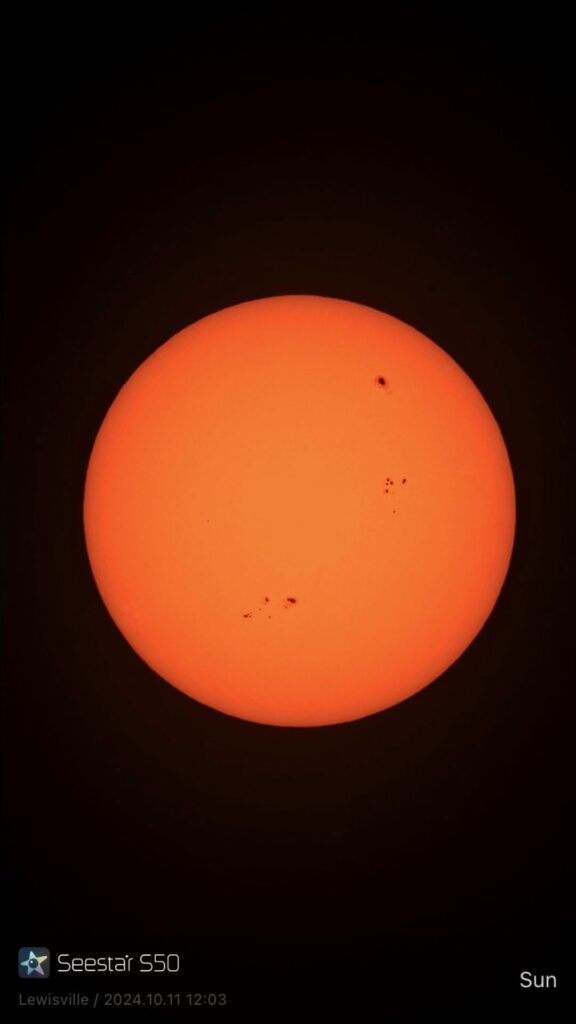


Seestar S50 images, Credit: Bruce Gavett


Dwarf 2 & Dwarf Mini images, Credit: Sean Wood
Build Your Own “Smart Telescope”
Another interesting approach is found in a YouTube video by The Space Kuala (Build Your Own Smart Scope! Easy as a SeeStar, Pro results!). It utilizes a smart camera from ZWO, a mount also from ZWO, and the Askar V telescope. Below is a list of the hardware discussed in the video (along with a few other choices).

- Telescope: Askar V
- Camera: ZWO ASI585MC Air or ASI2600MC Air
- Mount: ZWO AM3N or AM5N
- Focuser: ZWO EAFN or ZWO EAF Pro

The Askar V might be hard to find, however, it is still available at High Point Scientific as of January 2026. There are several other options for the telescope. Askar has a couple alternatives (SQA55 and SQA70). You could also go with a ZWO telescope (FS65, FS80, FS107, FS130). A third option are the Redcat telescopes from Williams Optics (CAT 51, CAT 61, CAT 71, CAT 91). See telescopes for astrophotography for more suggestions.
Find out more from FAS about smart telescopes, astrophotography, and telescopes in general below.
Please note that FAS does not officially endorse or recommend these or any other telescope or accessory. We simply provide information that might be interesting and useful for the public.
You must be logged in to post a comment.